Beds, Carriers & Daily Care
How to Trim Cat Nails
Nobody trims sixteen claws on the first attempt. The people who manage it eventually are the ones who started with one.
Affiliate disclosure: we earn a commission if you buy through our links, at no extra cost to you. It never changes which product we rank first — here is how we're funded.
Everyone in this category says they tested twenty litter boxes. We have not tested any, and we say so. What we do instead: compile the published specs, read the manuals, and do the arithmetic on what this gear costs to run and how it behaves once there is more than one cat using it. Every spec is linked to the document it came from. Prices are checked daily — last verified September 25, 2026. Here is exactly how we pick.
Claw trimming fails for one reason: people attempt the whole set on a cat that has not agreed to having its feet held.
What you are cutting, and what you are not
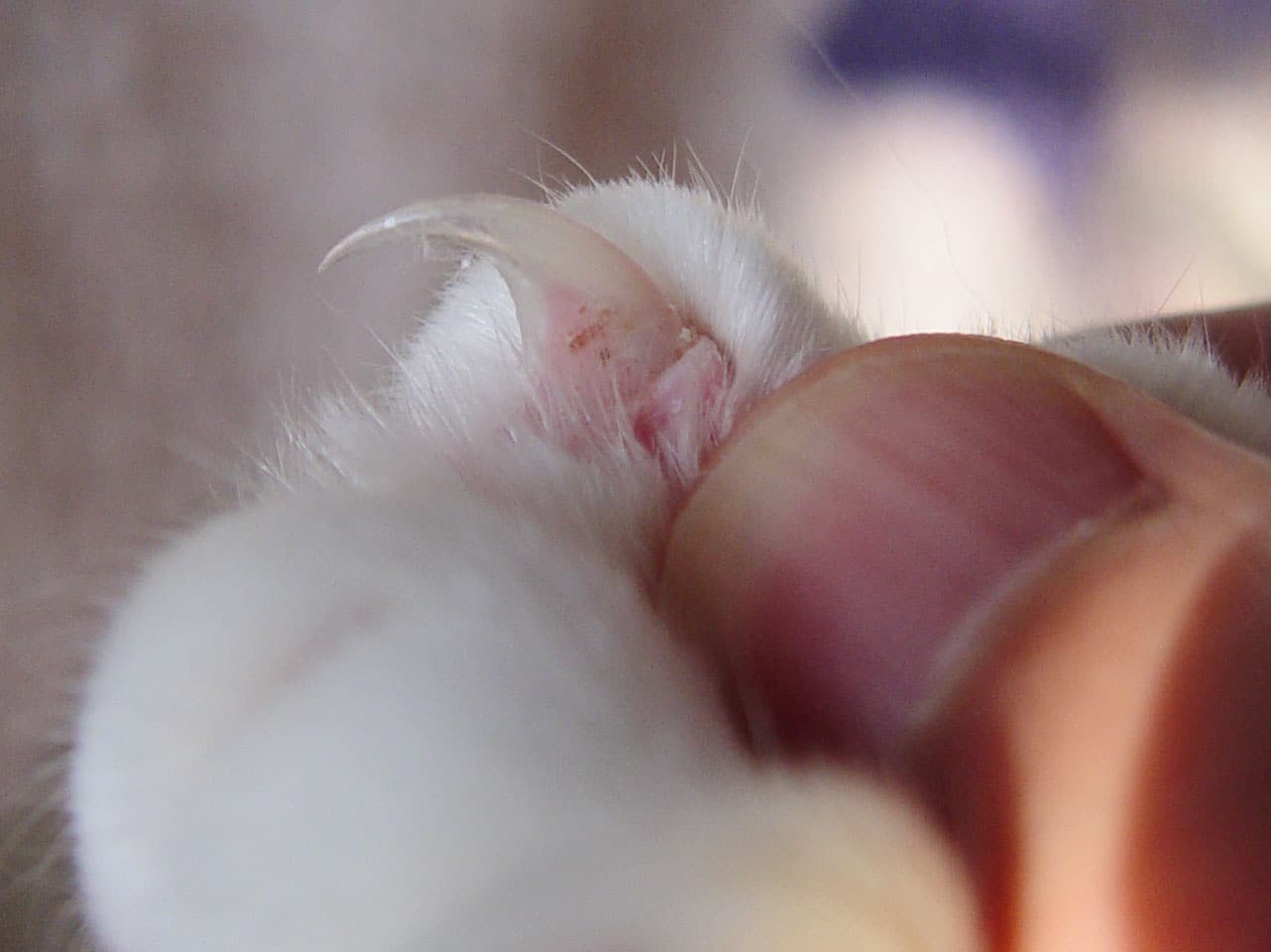
A cat’s claw is a curved hook with a pink wedge inside the base -- the quick, which carries blood and nerve. Hold a paw up to the light, press the pad gently so the claw extends, and you can usually see where the pink stops.
You are cutting the clear hook in front of the quick and nothing else. That is a small amount: the sharp tip, not a length of nail. Our filing scratcher page makes the related point that blunting a tip and shortening a claw are different jobs.
The routine that works
- Days 1-3: paws only. Hold a paw for two seconds, treat, release. Nothing else. Repeat a few times a day.
- Days 3-5: extend a claw. Press the pad, let the claw out, treat, release. Still no clipper.
- Day 5 onward: one claw. Cut a single tip, treat, and stop even if the cat seems fine. Ending early is what buys the next session.
- Build to a paw, then to the two front paws in one sitting.
- Pick your moment. A sleepy cat after a meal is a different animal from one that has just been playing.
The three tools
A small scissor clipper is the default and the one most cats accept: silent, instant, and sized for a cat claw rather than scaled down from a dog tool. The small blade is the safety feature, because there is less claw in the jaws per cut.
A quiet grinder suits people who find clippers nerve-wracking, since it removes tip gradually rather than in one irreversible action. It publishes 45 dB and a 7,000 RPM floor -- use the lowest setting, one second at a time, because friction makes heat. Our grinder page covers that technique.
Nail caps are the alternative when trimming is genuinely impossible or the damage is ongoing: published sizing by cat weight and a four to six week wear cycle, which our nail cap page costs out honestly.
What not to do
- Do not scruff or restrain hard. It works once and poisons every session after it.
- Do not use human nail clippers, which crush rather than cut a curved claw.
- Do not chase the last two claws. Finish tomorrow.
- Do not treat trimming as a substitute for scratching surfaces. Scratching is a need, not a nail-length problem -- our why cats scratch page covers that, and the Ohio State Indoor Pet Initiative lists scratching among an indoor cat’s basic needs.
The gear discussed here
Specs are the manufacturer's own, linked to the page they came from. Prices come from a live daily check; where we have no verified price we say so rather than print a stale one.
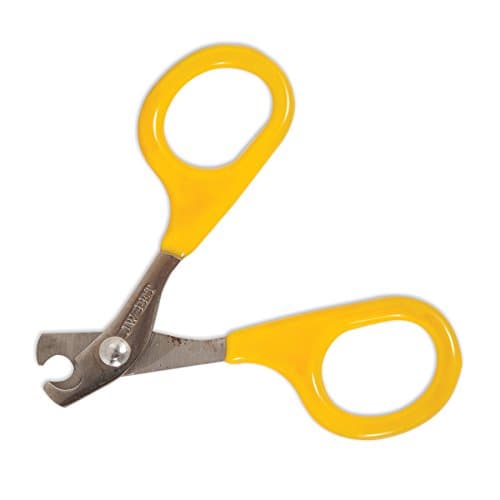
JW Pet GripSoft Cat Nail Clipper
JW Pet · Nail clipper · Our score 7.7/10
#ad Price as of September 25, 2026. Prices move; we check daily. How we're funded.
Small stainless blades on a non-slip handle, sized for a cat rather than sold as a universal pet tool -- and the small blade is the safety feature.
Published specs
| Blades | Stainless steel |
|---|---|
| Style | Scissor-style clipper sized for cats |
| Handle | Non-slip rubber GripSoft |
| Suits | Cats, small dogs, birds, reptiles |
| Blade dimensions | Not published |
Source: JW Pet -- GripSoft Cat Nail Clippers listing (stainless steel blades, non-slip GripSoft handle)
A large blade takes the whole claw in one bite, which means the cut happens before you can judge where the quick is. A short cat-sized blade only admits the tip, so the worst case is a cut that is too short rather than one that is too deep. That is the entire argument for buying a cat clipper rather than a dog one.
What the specs favor
- Sized for a cat claw rather than scaled down from a dog tool
- Stainless blades, named on the spec
- Non-slip handle, which matters when a cat pulls mid-cut
- Cheap enough to replace when the edge dulls
What they don't
- No published blade dimensions
- Blunts with use and there is no way to tell except by feel
- Scissor style gives less leverage than a guillotine on a thick claw
Your cat has never had its paws handled. Start with handling and touch, not with a tool -- and if the claws are already overgrown or ingrown, that is a veterinary visit.
How it scores
Scores are our editorial weighting of the published specs above, not a test result. They are deliberately kept out of this page's structured data.
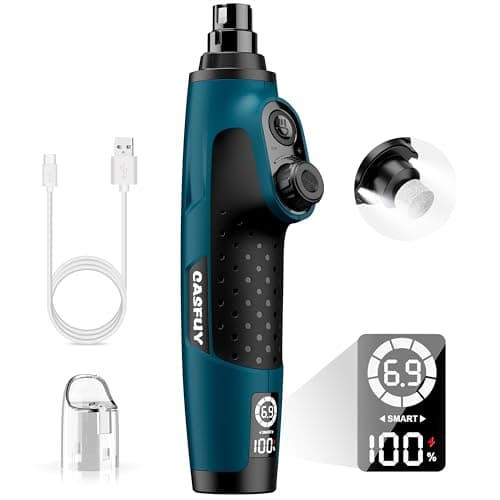
Casfuy 6-Speed Quiet Nail Grinder
Casfuy · Nail grinder · Our score 8.3/10
#ad Price as of September 25, 2026. Prices move; we check daily. How we're funded.
Six speeds from 7,000 to 12,000 RPM at a published 45 dB -- the noise figure is the one that decides whether a cat sits still for it.
Published specs
| Speeds | 6, from 7,000 to 12,000 RPM |
|---|---|
| Noise | 45 dB (published) |
| Battery | 2,000 mAh; up to 7 hours |
| Grinding ports | 3 |
| Extras | 2 LED lights, diamond bit, dust cap |
| Charging | USB-C |
A grinder removes nail by friction, and friction makes heat. On a cat's small claws, a few seconds at high speed in one spot is enough to be uncomfortable. The 7,000 RPM floor and the small port are what make this usable on a cat. Touch, lift, move -- never hold the bit on one claw.
What the specs favor
- Published 45 dB, quiet for the category
- Low 7,000 RPM floor suits small claws
- Small port sized for cat claws
- LEDs help you see where the quick starts
What they don't
- Any grinder is noisier than a clipper
- Needs a gradual introduction over days
- Claw dust needs cleaning up
Your cat panics at buzzing. A small scissor clipper is silent, and our clipper page covers the technique.
How it scores
Scores are our editorial weighting of the published specs above, not a test result. They are deliberately kept out of this page's structured data.
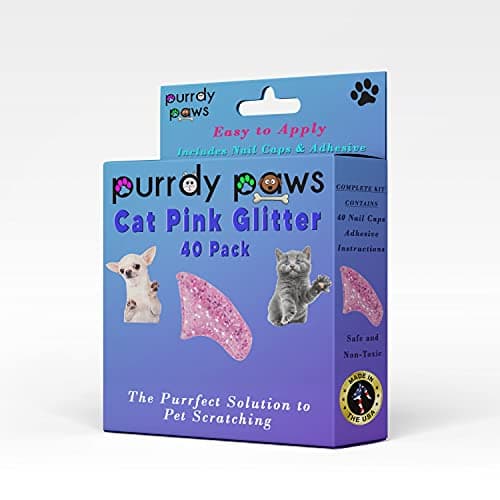
Soft Claws Cat Nail Caps
Soft Claws · Nail caps · Our score 7.3/10
#ad Price as of September 25, 2026. Prices move; we check daily. How we're funded.
Publishes a size chart by cat weight, an adhesive quantity per cap and a wear window in weeks, which makes it the only product in this category you can plan around.
Published specs
| Pack | 40 caps and 2 tubes of adhesive |
|---|---|
| Kitten | Up to about 5 lb, about 5 months |
| Small | About 6 months, 6 to 8 lb |
| Medium | About 9 to 13 lb |
| Large | About 14 lb and up |
| Wear time | 4 to 6 weeks before reapplying |
| Removal | Remove manually if not shed by 8 weeks |
| Material | Vinyl; claws still extend and retract |
| Adhesive | Fill each cap one third full |
At a published 4 to 6 week wear window, a year needs 8.7 to 13 applications of up to 10 caps each. That is the commitment, and it is why nail caps suit a specific problem -- a person on blood thinners, a cat that has to stop scratching skin -- rather than being a general furniture answer.
What the specs favor
- Publishes sizes by cat weight, which almost no nail-cap brand does
- Publishes a wear window and a removal deadline
- Claws still extend and retract, so normal behavior continues
- Adhesive quantity per cap published, which is where most failed applications go wrong
What they don't
- Every 4 to 6 weeks, forever, on a cat that must tolerate paw handling
- Caps that stay past 8 weeks must be removed by hand, not left
- They do not stop the cat scratching -- they only blunt the result
- A cap over a claw that needed trimming first traps the overgrowth
You want the scratching itself to stop. Nail caps change what a scratch does to a surface; the need to scratch is unaffected, and a post is still required.
How it scores
Scores are our editorial weighting of the published specs above, not a test result. They are deliberately kept out of this page's structured data.
Common questions
How do you cut a cat's nails safely?
How often do cat nails need trimming?
What if I cut the quick?
Do I need to trim the back claws?
My cat will not let me near its paws. What now?
Sources
- JW Pet -- GripSoft Cat Nail Clippers listing (stainless steel blades, non-slip GripSoft handle)
- Casfuy -- Quiet 6-Speed Pet Nail Grinder listing (45 dB, 7,000-12,000 RPM, 2 LED lights, 3 ports, rechargeable)
- Soft Claws -- Cat Nail Caps listing (40 caps and 2 adhesive tubes, kitten/small/medium/large by weight, 4-6 weeks wear, vinyl)
- Ohio State University Indoor Pet Initiative -- For Cat Owners
Read next
- Best Cat Nail Clippers (2026)
Cat nail clippers compared, why blade size is the safety feature, and a handling routine that makes trimming possible.
- Best Cat Nail Grinders (2026)
Nail grinders compared on published noise, speed range and battery life, against the silent clipper alternative.
- Best Cat Nail Caps (2026)
Nail caps compared on published sizing and wear window, who they genuinely suit, and what they do not replace.
- Cat Grooming Schedule
A grooming calendar built from published manufacturer intervals, with the total time cost per cat per year.
- Best Nail Filing Cat Scratchers (2026)
Nail-filing scratchers compared on published dimensions, with an honest account of what an abrasive surface can and cannot do to a claw.