Beds, Carriers & Daily Care
How to Get a Cat Into a Carrier
By the time you are chasing a cat around a bedroom, the decision that mattered was made when you bought a front-loading carrier.
Affiliate disclosure: we earn a commission if you buy through our links, at no extra cost to you. It never changes which product we rank first — here is how we're funded.
Everyone in this category says they tested twenty litter boxes. We have not tested any, and we say so. What we do instead: compile the published specs, read the manuals, and do the arithmetic on what this gear costs to run and how it behaves once there is more than one cat using it. Every spec is linked to the document it came from. Prices are checked daily — last verified October 22, 2026. Here is exactly how we pick.
The carrier fight is one of the most disliked jobs in cat keeping, and almost all of it is decided by two things you can arrange in advance.
First: the door layout
A cat that does not want to go in a front-loading carrier braces all four legs on the rim of the opening. There is no gentle technique that overcomes that, because the cat is stronger than the angle you are working at.
A top opening reverses the geometry: the cat is lifted and lowered rather than pushed. Cornell Feline Health Center makes the same point in its carrier guidance about carriers whose tops open or come off.
Second: what the carrier means
A carrier that lives in a cupboard and appears twice a year is a reliable signal. The cat is not afraid of a plastic box; it has learned what the box predicts.
- Leave it out permanently, door open or removed, in a room the cat uses.
- Put soft bedding in it that smells of home.
- Feed near it, then in it. Move the bowl closer over a week or two.
- Put treats in it at random. The cat finds them without you being involved.
- Close the door for ten seconds, then open it. Build up over days.
- Take a short drive that ends at home. This is the step everyone skips, and it is what breaks the car-equals-vet association.
When the appointment is today
Preparation is the answer and sometimes there has not been any. In that case:
- Close doors first. Reduce the house to one room before the cat knows anything is happening.
- Do not chase. A chased cat goes under a bed and the job becomes an hour long.
- Top-load if you can. Lift the cat, support the back legs, lower it in rear-first.
- Back it in, if front-loading. Tail first, so the cat cannot see the opening it is entering and cannot brace against the rim.
- Stand the carrier on end as a last resort, and lower the cat in from above. It works, and it is undignified for everyone.
- Towel wrap. Wrap firmly, lower the whole bundle in, unwrap once inside.
The journey itself
Cover the carrier with a light blanket, leaving airflow at one end. Secure it on the footwell or belted on a seat — a carrier loose on a seat becomes a projectile under braking, which is the whole reason a crash-certified carrier exists.
If you are flying, a compressible soft carrier is the format built for an under-seat space, and our sizing guide covers what compression costs the cat in floor length.
Two cats, two carriers
The gear discussed here
Specs are the manufacturer's own, linked to the page they came from. Prices come from a live daily check; where we have no verified price we say so rather than print a stale one.
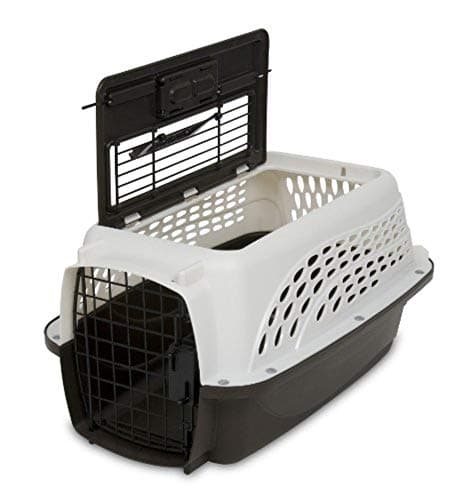
Petmate Two Door Top Load Kennel, 19 inch
Petmate · Cat carrier · Our score 7.6/10
#ad Price as of October 22, 2026. Prices move; we check daily. How we're funded.
A hard shell with a top door, which is the single feature that decides whether loading a frightened cat is a two-minute job or a twenty-minute one.
Published specs
| Exterior | 19.4" x 12.8" x 10" |
|---|---|
| Interior | 16.75" L x 11" W x 9.25" H |
| Published pet weight | Up to 10 lb |
| Carrier weight | 3.8 lb |
| Doors | Front steel door and top opening |
| Material | EcoTEC plastic, minimum 90 percent pre-consumer recycled |
| Assembly | Wing-nut and bolt |
Petmate: 16.75 x 11 x 9.25 = 1,705 cubic inches. Sleepypod Air at full extension: 21 x 9.5 x 9.5 = 1,894. Close -- but the Petmate is wider and shorter, and width is what a cat turning around actually needs.
What the specs favor
- Top loading, so a cat can be lowered in rather than pushed in
- Interior dimensions published, which soft carriers often omit
- Rigid shell does not collapse when a cat braces against it
- 90 percent recycled content published
What they don't
- Published for pets up to 10 lb, which is under the average adult cat
- Wing-nut assembly loosens and wants checking before each trip
- Hard shell does not compress for an under-seat space
Your cat is over 10 lb and the trip is long. Petmate publishes that figure for the 19 inch size, and the larger sizes exist for a reason.
How it scores
Scores are our editorial weighting of the published specs above, not a test result. They are deliberately kept out of this page's structured data.
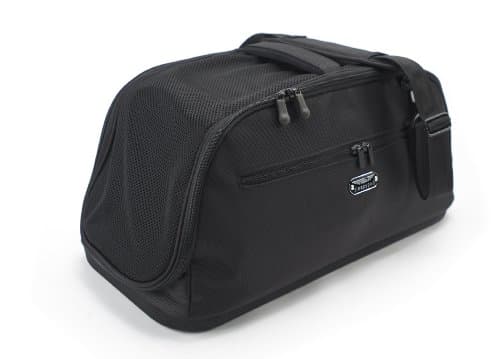
Sleepypod Air
Sleepypod · Cat carrier · Our score 8.9/10
#ad Price as of October 22, 2026. Prices move; we check daily. How we're funded.
The only carrier here with an independent crash certification attached to a published weight limit, and the only one whose length compresses from 22 inches to 16 to meet an under-seat space.
Published specs
| Exterior | 16 to 22" L x 10.5" W x 10.5" H |
|---|---|
| Interior | 15 to 21" L x 9.5" W x 9.5" H |
| Maximum pet weight | 18 lb (8 kg) |
| Carrier weight | 4.5 lb with privacy shield, 4.9 lb with shoulder strap |
| Safety | Crash-tested and certified by the Center for Pet Safety for pets up to 18 lb |
| Shell | Luggage-grade ballistic nylon, rip-stop mesh on four sides |
| Bedding | Removable machine-washable Ultra Plush |
Interior runs 15 to 21 inches. Compressing to fit an under-seat space removes 6 of 21 inches, 29 percent of the cat's floor length. A cat that is comfortable at 21 inches is folded at 15 -- so compress it on the aircraft, not for the whole trip.
What the specs favor
- Independent crash certification tied to a published weight limit
- Interior dimensions published, not just exterior
- Mesh on four sides, which is what international carriage rules tend to ask for
- Washable bedding included rather than sold separately
What they don't
- 18 lb published ceiling rules out large breeds
- 4.5 lb empty is heavy before the cat goes in
- Compressed length is a real reduction in the cat's space, not a design trick
Your cat is over 18 lb. That figure is both the manufacturer's limit and the boundary of the crash certification, so exceeding it discards the main reason to buy this carrier.
How it scores
Scores are our editorial weighting of the published specs above, not a test result. They are deliberately kept out of this page's structured data.
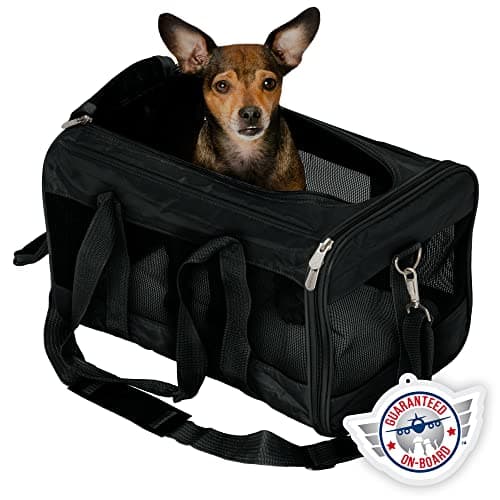
Sherpa Original Deluxe
Sherpa · Cat carrier · Our score 7.8/10
#ad Price as of October 22, 2026. Prices move; we check daily. How we're funded.
The spring wire frame lets the back end press down into an under-seat space, and the small and medium sizes carry Sherpa's own Guaranteed On Board program -- which is a commercial promise, not an aviation rule.
Published specs
| Small | 15" L x 10" W x 8.5" H, pets up to 8 lb |
|---|---|
| Medium | Pets up to 16 in long and 10 in tall, up to 16 lb |
| Large | Pets up to 18 in long and 11 in tall, up to 22 lb |
| Frame | Patented spring wire, rear end presses down several inches |
| Guaranteed On Board | Small and medium only; large is not in the program |
Sherpa publishes 8 lb for the small and 16 lb for the medium. A 12 lb cat is above the small's published limit by half again. People buy the small because it fits more under-seat spaces, and then find the published figure was the honest one.
What the specs favor
- Compresses at the rear to meet a published under-seat height
- Three sizes with a published pet weight for each
- Sherpa's own on-board guarantee covers the two smaller sizes
- Soft sides are far lighter than a comparable hard shell
What they don't
- Guaranteed On Board is Sherpa's program, not an airline rule -- the airline still decides
- Large size sits outside the guarantee entirely
- Soft sides give a determined cat something to push against
You want a carrier that doubles as car restraint. This one has no crash certification, and a soft carrier on a seat is not a restraint.
How it scores
Scores are our editorial weighting of the published specs above, not a test result. They are deliberately kept out of this page's structured data.
Common questions
How do you get a cat into a carrier that hates it?
Should you leave a cat carrier out all the time?
How do you get a cat in a carrier when you are in a hurry?
Why does my cat hate the carrier?
Should you cover a cat carrier with a blanket?
Sources
- Cornell Feline Health Center -- Do I Need a Cat Carrier?
- Petmate -- Two Door Top Load Kennel, 19 in (16.75 x 11 x 9.25 in interior, up to 10 lb)
- Sleepypod -- Sleepypod Air product page (15-21 x 9.5 x 9.5 in interior, 18 lb, Center for Pet Safety certified)
- Sherpa -- Original Deluxe Travel Pet Carrier listing (small up to 8 lb, medium up to 16 lb)
Read next
- Best Cat Carriers (2026)
Three carriers compared on published interior space, weight limits and crash certification -- and which of the three jobs each one is for.
- How to Size a Cat Carrier
The two measurements to take off your cat, and how to compare them against published interior and exterior carrier dimensions.
- Best Cat Strollers (2026)
Cat strollers compared on published interior length against carriers, and which cats a stroller genuinely suits.
- How to Introduce a New Cat
A staged cat introduction, the resource counts to have in place first, and the gear each stage actually needs.
- Best Cat Backpack Carriers (2026)
Cat backpacks compared on published pet dimensions and ventilation, with the honest limits on where a backpack should not be used.
- Best Cat Carriers for Two Cats (2026)
A double carrier compared against two singles on published interior volume, safety evidence and what happens at the vet.
- Best Top-Loading Cat Carriers (2026)
Carriers that open at the top, ranked on published opening type and dimensions, with the drawer design that answers the same problem another way.
- Traveling With a Cat by Car
Securing the carrier, building up with practice trips, and what a long drive actually needs -- including the stop rule that prevents escapes.