Feeders, Fountains & Bowls
Stainless vs Ceramic vs Plastic Cat Bowls
Three materials, three different failure modes, and one published number -- width against depth -- that matters more than all of them.
Affiliate disclosure: we earn a commission if you buy through our links, at no extra cost to you. It never changes which product we rank first — here is how we're funded.
Everyone in this category says they tested twenty litter boxes. We have not tested any, and we say so. What we do instead: compile the published specs, read the manuals, and do the arithmetic on what this gear costs to run and how it behaves once there is more than one cat using it. Every spec is linked to the document it came from. Prices are checked daily — last verified October 19, 2026. Here is exactly how we pick.
Buy stainless if you want a bowl that will outlive the cat and go through any dishwasher cycle; buy lead-free glazed ceramic if your cat shoves its dinner across the kitchen or you warm wet food; buy plastic only when the molding is the point, as it is in a slow feeder. Then check the width-to-depth ratio, because it matters more than any of the above.
The shape beats the material
Before any of this: a cat eats with its face in the dish, and a deep narrow bowl presses its whiskers against the sides the entire meal. The fix is a wide shallow dish, and it is a dimension you can check on a listing.
Dr. Catsby’s stainless dish: 7.08 inches across, 1.25 inches deep. 7.08 / 1.25 = 5.7 : 1.
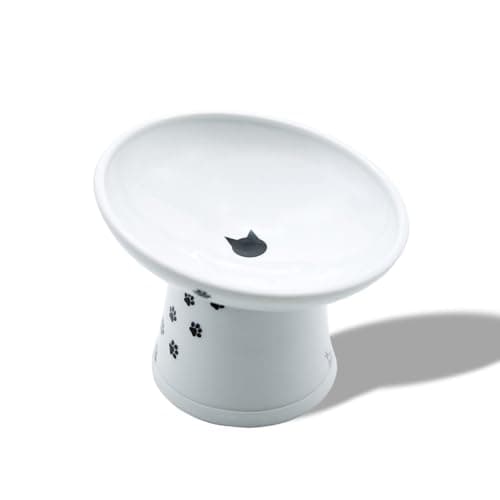
Necoichi raised porcelain: 6.1 inches wide, 1.18 inches deep. 6.1 / 1.18 = 5.17 : 1.
Both clear five to one, which is why both are on this page. A conventional round cat bowl is frequently nearer 2 : 1 — four inches across and two deep — and no material choice compensates for that.
So the order of operations is: find a dish over about 5 : 1, and then pick the material from what follows.
The three materials on published figures
| Stainless (Dr. Catsby's) | Ceramic (Necoichi raised) | Plastic (Outward Hound slow feeder) | |
|---|---|---|---|
| Material, as published | Stainless steel, one piece | Porcelain, free from lead and cadmium | 90% polypropylene, 10% thermoplastic elastomer |
| Width x depth | 7.08" dia x 1.25" deep | 6.1" W x 4.13" L x 1.18" D | 11.75" x 11.75" x 2.0" (medium) |
| Width-to-depth ratio | 5.7 : 1 | 5.17 : 1 | Not meaningful -- it is a maze |
| Weight | 14.1 oz (0.88 lb) | 1.2 lb | Not published |
| Capacity | Holds a 5 oz can of wet food | Not published | 3/4 cup, 2 cups, 4 cups by size |
| Dishwasher | Dishwasher safe | Dishwasher and microwave safe | Top rack only |
| Elevation | None -- flat, with silicone mat | 2.75" legs | None |
| Non-slip provision | Silicone mat included | Removable silicone ring | Non-slip base |
| Material safety claim | N/A for steel | Free from lead and cadmium | Free of BPA, PVC, lead, phthalate |
Manufacturers' and retailers' published figures as named in our sources. Where a maker does not publish a figure the cell says so rather than estimating.
Weight is the stability argument, and it is 36 percent
Porcelain: 1.2 lb. Stainless: 14.1 oz, which is 0.88 lb.
1.2 / 0.88 = 1.36, so the ceramic bowl is 36 percent heavier than the steel one of comparable size.
That is the entire case for ceramic, and it is a real one: a cat that paws at its food, or pushes the dish while eating, is applying a sideways force that a heavier object resists better. Both bowls here hedge with silicone — a mat under the steel, a removable ring under the porcelain — which tells you the makers know mass alone does not settle it.
The flip side is handling. A 0.88 lb steel dish is the one you carry to the sink twice a day without thinking; a porcelain one is the one that chips when it meets a tile floor. Neither is wrong. They fail in different directions, and which failure you would rather have is the decision.
What plastic actually does wrong
Plastic’s problem is not that it is plastic. The Outward Hound feeder here publishes a specific composition — 90 percent polypropylene, 10 percent thermoplastic elastomer — and states it is free of BPA, PVC, lead and phthalate, which is more than most ceramic bowls disclose about their glaze.
The problem is that plastic is the only one of the three that changes over its life. Steel and fired glaze do not scratch under a cat’s tongue and a sponge; molded polypropylene does, and a scratched surface holds food residue where a rinse cannot reach it. The dishwasher rating tells the same story from another angle: this bowl is top rack only, because the bottom rack sits closer to the heating element and warps it. Steel and porcelain carry no such restriction.
The one thing to check on ceramic
Ceramic is the material where the published claim matters most, because the risk lives in the glaze rather than the clay. Necoichi publishes that its porcelain is free from lead and cadmium. That sentence is the reason to buy a named ceramic bowl rather than an unmarked one: an unbranded imported dish may be perfectly fine, and you have no way to know, and food sits in it twice a day for years.
Ceramic also earns a genuine capability the other two lack: it is the only one of the three rated microwave safe. If you warm wet food — and a lot of cats eat more of it warm — that is not a nicety, it is one fewer dish to wash.
The bowls behind the figures
Dr. Catsby’s stainless dish is the default recommendation and the material most households should buy. One piece of stainless, 7.08 inches across and 1.25 deep for a 5.7:1 ratio, holds a full 5 oz can, dishwasher safe with no rack restriction, and it ships the silicone mat that fixes its one weakness. The honest cons: at 14.1 oz it is the lightest bowl here and will slide without that mat, there is no elevation at all, 5 oz is modest capacity, and steel shows every water spot.
The Necoichi raised porcelain bowl is the pick for a cat that shoves its dinner around, or one that does better eating slightly raised. 1.2 lb of porcelain published free from lead and cadmium, 2.75 inch legs, a 5.17:1 extra-wide dish, a removable silicone ring, and the only bowl here you can microwave. The honest cons: porcelain chips, Necoichi publishes no capacity figure, the 4.17 inch base is narrow for the height, and it costs more than the steel dish it is competing with on shape.
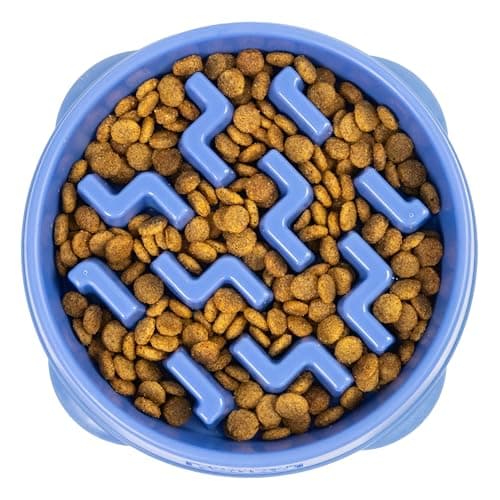
The Outward Hound Fun Feeder is on this page as the honest case for plastic, not as a general-purpose bowl. The published composition is specific, the BPA/PVC/lead/phthalate claims are explicit, three difficulty levels are offered, and the 3/4 cup size is the one a cat needs. The honest cons: top-rack dishwasher only, it scratches and should be treated as replaceable, the ridged maze is the opposite of whisker-friendly, and the two larger sizes are dog products in a cat listing.
Deciding in one pass
- Measure width and depth from the listing. Under about 5 : 1, stop — the material will not save it.
- Ask whether the bowl moves. If your cat pushes it, go ceramic for the 36 percent extra mass, or insist on the silicone mat.
- Ask whether you warm wet food. If yes, ceramic is the only one of the three that goes in the microwave.
- Check the dishwasher wording. “Top rack only” is a material disclosure, not a detail.
- If it is ceramic, find the lead and cadmium claim. No claim is your answer.
On how much food goes in the dish and how often, we defer to people qualified to say: the Ohio State Indoor Pet Initiative covers feeding for indoor cats. We are not veterinarians. What we can do is read the dimensions.
See the bowls
Our main bowl roundup ranks the category on published dimensions, the water bowls page handles the other half of the station, and elevated bowls works through whether the legs are worth paying for. The same material question for fountains is answered in fountain materials compared.
The gear discussed here
Specs are the manufacturer's own, linked to the page they came from. Prices come from a live daily check; where we have no verified price we say so rather than print a stale one.
Dr. Catsby's Food Bowl for Whisker Relief
Dr. Catsby · Cat bowl · Our score 8.2/10
#ad No verified live price right now, so we show none rather than a stale one. How we're funded.
A single piece of stainless 7.08 inches across and only 1.25 inches deep -- the shallow-and-wide geometry the whisker-fatigue argument actually calls for.
Published specs
| Diameter | 7.08" |
|---|---|
| Depth | 1.25" |
| Weight | 14.1 oz |
| Capacity | Holds a 5 oz can of wet food |
| Material | Stainless steel, one piece |
| Included | Silicone non-slip mat for the base |
| Cleaning | Dishwasher safe |
Source: Amazon -- Dr. Catsby's Food Bowl for Whisker Relief listing
7.08 inches wide divided by 1.25 inches deep = 5.7. A typical deep ceramic cat dish is nearer 2:1. That ratio is the entire whisker-fatigue argument expressed as a number you can check on any bowl before buying -- and almost no listing publishes both figures.
What the specs favor
- Published width and depth, so the ratio above is checkable
- One piece of stainless -- nothing to scratch and harbor residue
- Silicone mat included rather than sold separately
- Dishwasher safe
What they don't
- 1.25 inches deep is shallow for a large dry-food portion
- Stainless is light enough that a determined cat can move it
- One bowl per cat gets expensive in a multi-cat house
You free-feed a big daily ration of dry food. A 1.25-inch dish is sized around a 5 oz can, not around a cup of kibble.
How it scores
Scores are our editorial weighting of the published specs above, not a test result. They are deliberately kept out of this page's structured data.
Necoichi Raised Cat Food Bowl
Necoichi · Cat bowl · Our score 8.3/10
#ad Price as of October 19, 2026. Prices move; we check daily. How we're funded.
Elevated porcelain on a 2.75-inch leg with a published lead-and-cadmium-free glaze -- the one bowl here that addresses neck posture as well as whisker clearance.
Published specs
| Extra-wide dimensions | 6.1" W x 4.13" L x 1.18" D |
|---|---|
| Leg height | 2.75" |
| Base width | 4.17" |
| Weight | 1.2 lb |
| Material | Porcelain, free from lead and cadmium |
| Cleaning | Dishwasher and microwave safe |
| Included | Removable non-slip silicone ring |
Source: Chewy -- Necoichi Extra Wide Raised Cat Food Bowl listing
1.2 lb of porcelain against 14.1 oz (0.88 lb) for the stainless Dr. Catsby, plus a wider 4.17-inch base. Roughly 36 percent more mass on a wider footprint is why a ceramic bowl stays where you put it and a light stainless one travels across the kitchen.
What the specs favor
- Raised 2.75 inches, which changes eating posture as well as whisker contact
- Published lead-free and cadmium-free porcelain
- Heaviest bowl here, on the widest base -- it does not slide
- Dishwasher and microwave safe
What they don't
- Porcelain chips if it is dropped; stainless does not
- 1.18 inches deep in the extra-wide version is shallow for dry food
- Costs more than a plain dish
Your cat is a kitten or has mobility problems that make reaching up awkward. Elevation helps some cats and is simply an obstacle for others.
How it scores
Scores are our editorial weighting of the published specs above, not a test result. They are deliberately kept out of this page's structured data.
Outward Hound Fun Feeder Slo Bowl
Outward Hound · Slow feeder bowl · Our score 7.2/10
#ad Price as of October 19, 2026. Prices move; we check daily. How we're funded.
Published capacities per size and three named difficulty levels, so you can match the maze to the cat instead of buying the deepest one and watching it get abandoned.
Published specs
| Capacities | 3/4 cup, 2 cups, 4 cups by size |
|---|---|
| Medium dimensions | 11.75" L x 11.75" W x 2.0" H |
| Material | 90 percent polypropylene, 10 percent thermoplastic elastomer |
| Base | Non-slip |
| Dishwasher | Top rack safe |
| Difficulty levels | Slow, Slower, Slowest |
| Free of | BPA, PVC, lead, phthalate |
A typical adult cat eats well under a cup of dry food a day, split across meals. The 2 cup medium is sized for a small dog. Buying the small is not a compromise here -- it is the size where a cat's actual portion covers enough of the maze to slow it down.
What the specs favor
- Capacity published per size rather than one vague figure
- Three difficulty levels, so a cat that gives up can be stepped down
- Top-rack dishwasher safe, which a wet-food bowl needs to be
- Materials named, including what it is free of
What they don't
- Sized and marketed for dogs first; the cat-appropriate size is the smallest
- Deep grooves are awkward to hand-wash
- Plastic, so it scratches -- see our bowls page on why that matters
Your cat is losing weight or eating less than usual. Slowing a cat that has stopped eating properly is the wrong intervention, and that is a veterinary conversation first.
How it scores
Scores are our editorial weighting of the published specs above, not a test result. They are deliberately kept out of this page's structured data.
Common questions
What is the best type of bowl for cats?
Are stainless steel or ceramic cat bowls better?
Are plastic cat bowls bad?
Should a cat bowl go in the dishwasher?
Does a ceramic cat bowl need to be lead free?
Sources
- Amazon -- Dr. Catsby's Food Bowl for Whisker Relief listing
- Chewy -- Necoichi Extra Wide Raised Cat Food Bowl listing
- Outward Hound -- Fun Feeder Slo Bowl listing (3/4 cup, 2 cup and 4 cup sizes, 11.75 x 11.75 x 2.0 in medium, top-rack dishwasher safe)
- Ohio State University Indoor Pet Initiative -- Food and feeding for indoor cats
Read next
- Best Cat Food Bowls (2026)
Bowls compared on published width-to-depth ratio, material and elevation, with the whisker-fatigue claim handled carefully.
- Best Cat Water Bowls (2026)
Plain water bowls compared on width, material and stability, with the running-cost case against a fountain.
- Are Elevated Cat Bowls Worth It?
Elevation against width-and-depth, worked from published bowl dimensions -- with a clear line between what specs can settle and what they cannot.
- Ceramic vs Stainless vs Plastic Cat Fountains
Why the material debate is really about scratch resistance, and what that means for a fountain in a multi-cat house.
- Best Slow Feeder Cat Bowls (2026)
Slow feeder bowls compared on published capacity and why the smallest size is the one a cat needs.