Cat Trees, Shelves & Perches
How to Repair a Cat Tree
Three of the four common failures are worth fixing. The fourth means the tree is finished, and knowing which is which saves an afternoon.
Affiliate disclosure: we earn a commission if you buy through our links, at no extra cost to you. It never changes which product we rank first — here is how we're funded.
Everyone in this category says they tested twenty litter boxes. We have not tested any, and we say so. What we do instead: compile the published specs, read the manuals, and do the arithmetic on what this gear costs to run and how it behaves once there is more than one cat using it. Every spec is linked to the document it came from. Prices are checked daily — last verified October 22, 2026. Here is exactly how we pick.
A cat tree is a consumable wrapped around a structure. The consumable parts are worth renewing several times; the structure is not repairable at all, and telling them apart is the whole skill.
Triage
| Symptom | Cause | Verdict |
|---|---|---|
| Shredded sisal on a post | Normal wear -- sisal is a consumable | Repair: re-wrap |
| Bolt spins and never tightens | Stripped hole in particleboard | Repair: glue and dowel, or a longer bolt |
| Wobble that returns after tightening | Assembled out of square | Repair: loosen everything, re-square, re-tighten |
| Platform sags under the cat | Particleboard core has failed | Replace the tree |
Our triage. The last row is the one people try hardest to fix and the one that cannot be fixed.
Re-wrapping a post
- Cut the old rope off and pull out every staple. Leaving old fixings under new rope guarantees a lumpy wrap.
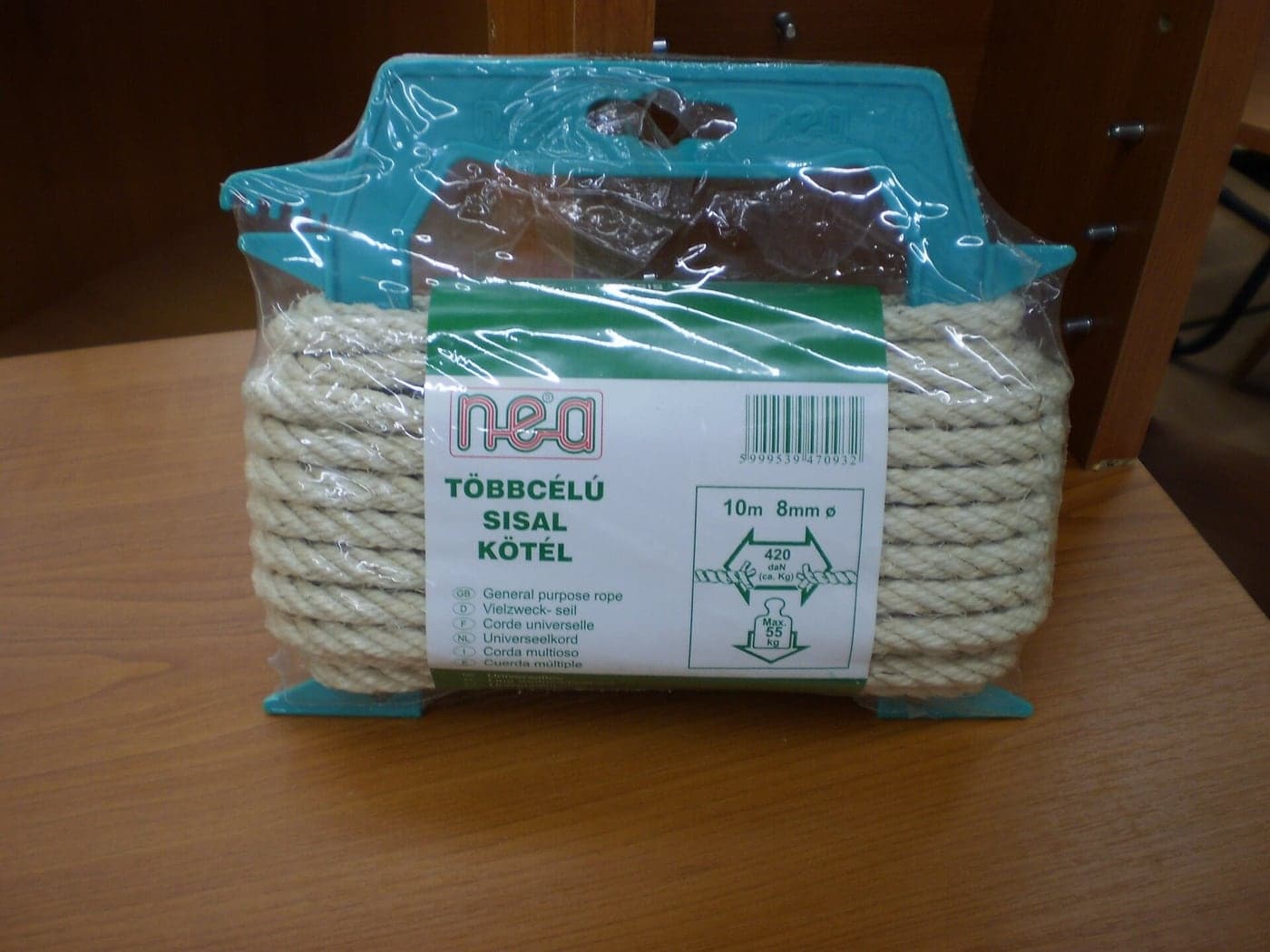
- Buy sisal rope, not twine. Match the diameter to what came off — typically around 6 mm on cat furniture — so the turn count works out.
- Fix the top end first. Staple or tack it into the post, then wrap downward.
- Wrap under constant tension. Each turn hard against the last. A loose wrap unravels the first time a cat pulls on it.
- Fix the bottom end and trim. Tuck the cut end under the previous turn before fixing it.
- Check for protruding staples with your hand before the cat does with its paws.
This is worth doing because sisal is the part cats actually consume. A well-made standalone post is built around the same idea — the rope wears out, the structure does not — and our carpet against sisal comparison covers why cats prefer it.
Stripped holes
A bolt in particleboard grips by compressing fiber around the thread. Every tightening cycle crushes that fiber a little further, and eventually there is nothing left to compress.
The repair is to give it new material: wood glue with a dowel, or packed matchsticks, left to dry fully before re-drilling. Rushing the drying is why this repair fails.
The alternative is a longer bolt reaching fresh material, with a washer to spread the load. Both are cheap. Neither works if you keep applying force to the original hole first.
Wobble that comes back
If a tree wobbles again a week after tightening, it was assembled out of square and tightening one joint at a time is pulling it further out. Loosen everything, stand it up, confirm it is square, and re-tighten progressively across the tree. That is the same procedure as our assembly guide, applied to a tree that is already built.
When to stop repairing
Replace it if a platform sags, if the base has swollen from water, or if the tree has been repaired at three or more joints. A 57.5 lb tower that fails while a cat is six feet up is a serious event, and a heavily repaired tree is one where you no longer know which joint is the weakest.
If you are replacing anyway, a tree that publishes per-platform weight limits tells you something the repaired one never did.
The gear discussed here
Specs are the manufacturer's own, linked to the page they came from. Prices come from a live daily check; where we have no verified price we say so rather than print a stale one.
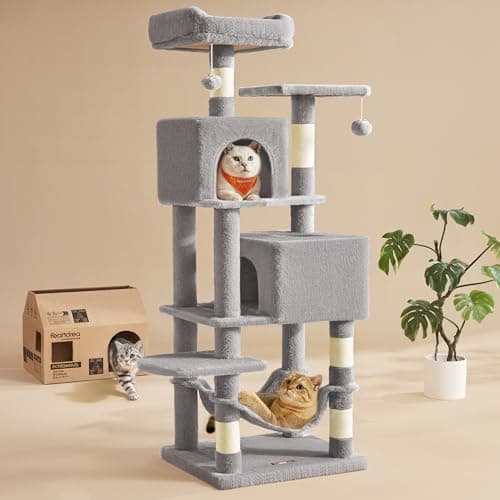
FEANDREA 67-inch Multi-Level Cat Tree
FEANDREA · Cat tree · Our score 8.6/10
#ad Price as of October 22, 2026. Prices move; we check daily. How we're funded.
The best base-to-height ratio of any tree here, and base-to-height is the only spec that predicts whether a tree rocks when a 15 lb cat lands on the top perch.
Published specs
| Dimensions | 24" L x 19.3" W x 67" H |
|---|---|
| Assembled weight | 57.5 lb |
| Materials | Particleboard, plush, sisal rope |
| Post diameter | 3.4" sisal-wrapped |
| Per-platform rating | Not published in the retail listing |
Source: Chewy -- FEANDREA 67-in Multi-Level Cat Tree listing
Our figure, not the maker's: shortest base dimension divided by height, multiplied by assembled weight. 19.3 / 67 = 0.288, x 57.5 lb = 16.5. The Yaheetech 72-inch scores 8.7 on the same sum and the Go Pet Club F2081 scores 15.9. Higher is harder to tip. Redo it yourself on any tree from two published numbers.
What the specs favor
- Heaviest tree here at 57.5 lb, and weight is what resists tipping
- Widest base relative to height of the three trees on this page
- 3.4-inch sisal posts are thick enough for a large cat to actually pull against
- Multiple platforms so two cats are not forced to share one
What they don't
- Particleboard, so it does not survive being moved often
- 57.5 lb is a two-person assembly
- FEANDREA does not publish a per-platform weight rating in the retail listing
You move house often or rearrange furniture. Particleboard trees come apart badly and go back together worse.
How it scores
Scores are our editorial weighting of the published specs above, not a test result. They are deliberately kept out of this page's structured data.
SmartCat Ultimate Scratching Post
Pioneer Pet · Scratching post · Our score 8.9/10
#ad Price as of October 22, 2026. Prices move; we check daily. How we're funded.
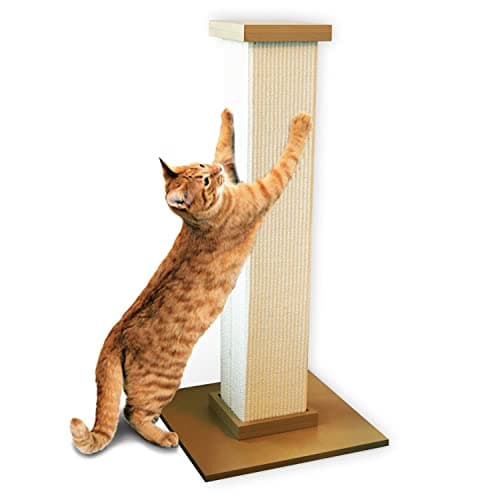
32 inches tall on a 16-inch square base in woven sisal -- tall enough for a full stretch, which is the single reason cats reject most posts.
Published specs
| Dimensions | 32" H x 16" W x 16" D |
|---|---|
| Base | 16" x 16" |
| Surface | Woven sisal fabric |
| Orientation | Vertical |
Source: Pioneer Pet -- #3832 The Ultimate Scratching Post product page
A large domestic cat stretched from front claws to hind feet runs roughly 30 inches. At 32 inches this post clears that; a typical 20-inch post from a pet-shop shelf does not, which is why the cat goes back to the sofa arm -- the sofa is tall enough and the post is not.
What the specs favor
- 32 inches is taller than the great majority of retail posts
- 16 x 16 inch base, which is what stops it rocking mid-scratch
- Woven sisal fabric rather than carpet, so it does not teach the cat that carpet is for scratching
- Nothing on it to wear out but the sisal
What they don't
- Only one scratching surface
- Vertical only, and some cats are horizontal scratchers
- Plain -- it looks like what it is
Your cat scratches the carpet rather than the furniture. That is a horizontal scratcher, and a vertical post will not redirect it.
How it scores
Scores are our editorial weighting of the published specs above, not a test result. They are deliberately kept out of this page's structured data.
Yaheetech 72-inch Cat Tree Tower
Yaheetech · Cat tree · Our score 6.8/10
#ad Price as of October 22, 2026. Prices move; we check daily. How we're funded.
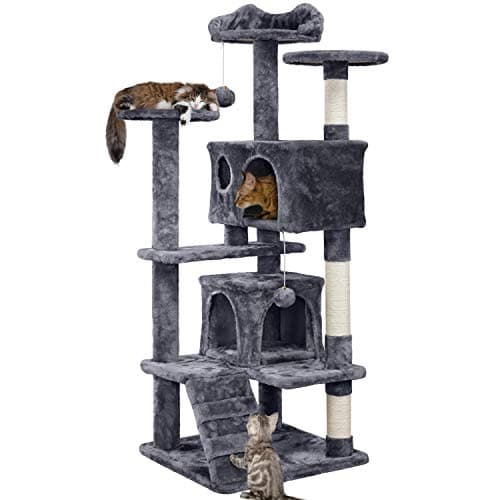
One of the very few trees whose maker publishes a per-platform weight limit -- 11 lb on a platform, 22 lb in a condo. Read those numbers before you buy for a big cat.
Published specs
| Dimensions | 19" L x 19" W x 72" H |
|---|---|
| Top platform | 13.6" x 12" |
| Condo rating | 22 lb (10 kg) |
| Platform rating | 11 lb (5 kg) |
| Assembled weight | 33.1 lb |
Source: Yaheetech -- 72-inch Height Cat Tree Tower product page
19 / 72 = 0.264, x 33.1 lb = 8.7 -- about half the FEANDREA's 16.5 on the same sum. Taller, narrower and 24 lb lighter is the worst combination for tipping. If you buy this one, wall-anchor it.
What the specs favor
- Publishes per-platform and per-condo weight ratings, which almost no maker does
- 72 inches of height in a 19-inch square footprint
- Fits a corner where a wider tree will not
What they don't
- Stability index of 8.7 -- the least stable tree on this page by our own sum
- 11 lb platform rating rules it out for most large breeds
- Top platform is only 13.6 x 12 inches
Your cat is over 11 lb. Yaheetech's own published platform rating is 11 lb, and a 16 lb Maine Coon on an 11 lb platform is the maker telling you not to.
How it scores
Scores are our editorial weighting of the published specs above, not a test result. They are deliberately kept out of this page's structured data.
Common questions
Can you re-wrap a cat tree post with new sisal?
How do you fix a wobbly cat tree?
What do you do about a stripped bolt hole in a cat tree?
Is it worth repairing a cat tree?
How long should a cat tree last?
Sources
Read next
- How to Assemble a Cat Tree
The assembly order, tightening sequence and two-week re-check that decide whether a cat tree stays stable.
- Carpet vs Sisal on a Cat Tree
Why carpet-covered posts undermine the rest of your furniture, and what to look for in sisal instead.
- How to Clean a Cat Tree
A material-by-material cleaning routine for cat trees, and the water rule that keeps a particleboard tree intact.
- Best Cat Scratching Posts (2026)
Ranked on the three published specs that predict whether a cat uses a post: height, base width and surface material.
- How to Tell if a Cat Tree Is Stable (Before You Buy)
The stability index explained: how to compute it in a shop, what the numbers mean, and when to wall-anchor regardless.