Scratchers & Furniture Protection
Best Cat Scratcher Houses (2026)
Cardboard houses combine the two things cats most reliably want from a cheap object: somewhere to hide and something to scratch.
Affiliate disclosure: we earn a commission if you buy through our links, at no extra cost to you. It never changes which product we rank first — here is how we're funded.
Everyone in this category says they tested twenty litter boxes. We have not tested any, and we say so. What we do instead: compile the published specs, read the manuals, and do the arithmetic on what this gear costs to run and how it behaves once there is more than one cat using it. Every spec is linked to the document it came from. Prices are checked daily — last verified September 25, 2026. Here is exactly how we pick.
Quick picks
Ranked on the published specs and the arithmetic below. Tap any row to jump to the full write-up. We have not tested these — here is exactly how we pick.
| # | Product | Best for | Score | Price |
|---|---|---|---|---|
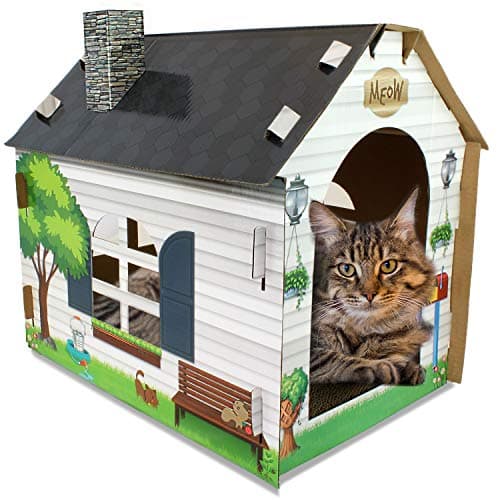
| 1 | ASPCA Cardboard Cat House with Scratch Pad A corrugated house with a scratch pad inside, at a published 19 by 13 by 17 inches -- big enough for an adult cat to turn around in, which is where most cardboard houses fail. | Cover and scratching in one cheap object | 7.3 | |
| 2 | 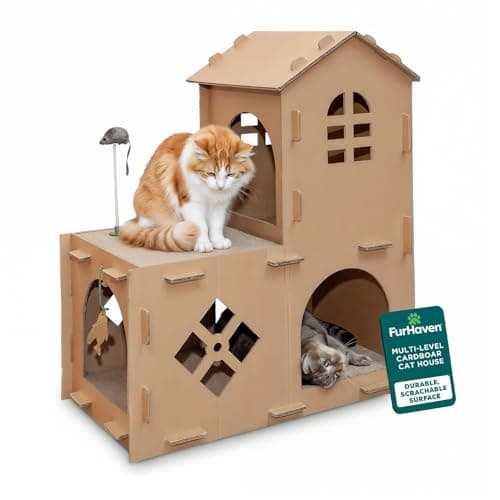 FurHaven Condo Hideaway Scratcher House A 15.75 inch tall scratcher house from a bedding maker -- shorter than the ASPCA house, and designed as a piece of floor furniture rather than a box. | A condo you do not mind being seen | 6.4 | |
| 3 | 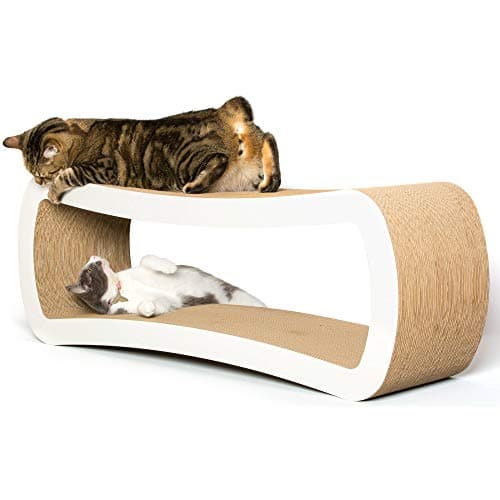 PetFusion Ultimate Cat Scratcher Lounge 34 inches of reversible corrugate -- the horizontal answer for the cat that is destroying carpet rather than furniture, and it doubles as somewhere to sleep. | Horizontal scratchers, and carpet-diggers | 8.0 |
#ad Buy links are affiliate links. Prices come from a live daily check; where we have no verified price we say "check price" rather than print a stale one.
Put an empty box on the floor and most cats will be in it within the hour. A scratcher house is that box with a scratch pad inside and a roof that does not collapse.
Why cats want the box
The Ohio State Indoor Pet Initiative lists places to hide and places to scratch among the basic environmental needs of an indoor cat. A box meets the first: an enclosed space where a cat can watch the room without being watched. Corrugated cardboard meets the second, and our sisal against cardboard page explains why it is the surface most cats accept first.
A scratcher house combines them, and at a low enough cost to be treated as a consumable. That last part is not a drawback — it is the correct way to think about any cardboard scratcher.
The turn-around test
A cat inside an enclosed space needs close to its own body length, nose to tail base, to turn around. Measure yours lying stretched out.
The ASPCA house publishes 19 by 13 by 17 inches. At 19 inches long, most adult cats can turn inside it. At 17 inches high, most can sit upright without the roof touching their ears.
FurHaven publishes only a height: 15.75 inches. That is an inch and a quarter lower than the ASPCA roof, and there is no published footprint or entrance size to check against your cat.
What the three publish
| Product | Dimensions | Cover | Scratch surface |
|---|---|---|---|
| ASPCA Cardboard Cat House | 19" L x 13" W x 17" H | Enclosed | Scratch pad inside |
| FurHaven Condo Hideaway | 15.75" H (other dimensions not published) | Enclosed | Built-in scratch surfaces |
| PetFusion Scratcher Lounge | 34" L x 10.5" W x 10.5" H | None | Reversible, both sides |
Manufacturers' and retailers' published figures. The PetFusion lounge is included as the open alternative for a cat that scratches but will not go into a box.
The picks
The ASPCA house wins on the only figure that decides whether a house gets used: it publishes an interior big enough for an adult cat to turn around. It is cheap, it is corrugated throughout, and when it wears out you buy another without regret.
The FurHaven Hideaway is designed to look like furniture rather than packaging, which matters if it is going in a living room. The cost is information: with only a height published, you are buying on trust. For a small or average cat, the trust is probably fine. For a large cat, buy the one that publishes its footprint.
The PetFusion lounge is the answer for a cat that likes cardboard but not boxes. It is open, 34 inches long and reversible, so its scratchable area doubles when you flip it. Some cats simply prefer to lie on top of things rather than inside them, and a house will not change that.
The one-exit problem
In a single-cat house, one entrance is fine. In a house with two or more cats and any tension between them, a box with a single exit is somewhere one cat can be cornered by another — the ambush geometry our tension guide describes around litter boxes.
- Place the entrance facing the room, not a wall, so the cat inside can see who is coming.
- Do not put it in a corridor. A house in a through-route is a house that gets walked past by the other cat every few minutes.
- Consider a tunnel instead. Our tunnel roundup covers three-way designs that give the same cover with more ways out.
Where to put one
- Near where the cat already rests, with a view of the room.
- Away from the litter box and food. A cat will not rest where it eliminates.
- On a hard floor or a rug that will not slide, so the house does not skate when the cat scratches inside it.
- Somewhere you can replace it without moving furniture. It will need replacing.
When to replace it
Replace a cardboard house when the scratch surface is shredded through, when the roof sags, or immediately if it is soiled — cardboard cannot be cleaned, and a house that smells of urine will be marked again. That is why a cheap house is the right buy and an expensive one is not: you are buying a consumable either way. The cardboard scratcher roundup covers refillable designs that reduce the waste.
The picks in full
Specs are the manufacturer's own, linked to the page they came from. Prices come from a live daily check; where we have no verified price we say so rather than print a stale one.
ASPCA Cardboard Cat House with Scratch Pad
ASPCA · Scratcher house · Our score 7.3/10
#ad Price as of September 25, 2026. Prices move; we check daily. How we're funded.
A corrugated house with a scratch pad inside, at a published 19 by 13 by 17 inches -- big enough for an adult cat to turn around in, which is where most cardboard houses fail.
Published specs
| Dimensions | 19" L x 13" W x 17" H |
|---|---|
| Material | Corrugated cardboard |
| Scratcher | Scratch pad included |
| Form | Enclosed hideaway |
Source: ASPCA -- Cardboard Cat House Hideaway Playhouse with Scratcher listing (19 x 13 x 17 in)
A cat needs close to its own body length, nose to tail base, to turn around inside an enclosed space. Measure yours: a 19 inch interior clears most adult cats, and a house a cat cannot turn in is a house it backs out of.
What the specs favor
- Large enough interior for an adult cat to turn around
- Cover and a scratching surface in one object
- Cardboard is the texture most cats accept first
- Cheap enough to treat as a consumable
What they don't
- Cardboard is a consumable and the house wears as it is scratched
- Not washable -- a soiled house is replaced, not cleaned
- One entrance on most layouts, which a nervous cat may not trust
Your household has tension between cats. An enclosed box with one exit is a place a cat can be cornered, and a three-way tunnel gives the same cover with more ways out.
How it scores
Scores are our editorial weighting of the published specs above, not a test result. They are deliberately kept out of this page's structured data.
FurHaven Condo Hideaway Scratcher House
FurHaven · Scratcher house · Our score 6.4/10
#ad Price as of September 25, 2026. Prices move; we check daily. How we're funded.
A 15.75 inch tall scratcher house from a bedding maker -- shorter than the ASPCA house, and designed as a piece of floor furniture rather than a box.
Published specs
| Height | 15.75" |
|---|---|
| Form | Condo hideaway with scratching surfaces |
| Other dimensions | See product page |
Source: Petco -- FurHaven Condo Hideaway Scratcher House for Cats listing (15.75 in high)
An inch and a quarter less height than the ASPCA house. Height matters inside an enclosed space because a cat sits up in it, and a roof that brushes the ears is a roof the cat leaves. Check your cat's sitting height before buying either.
What the specs favor
- Designed as furniture rather than packaging
- Scratching surfaces built into the house
- Low profile tucks beside a sofa
What they don't
- Only the height is published; footprint and entrance are not
- Shorter than the ASPCA house
- Scratch surfaces wear and are not replaceable
Your cat is large. Without a published footprint or entrance size you cannot check the fit before buying, and the ASPCA house publishes all three dimensions.
How it scores
Scores are our editorial weighting of the published specs above, not a test result. They are deliberately kept out of this page's structured data.
PetFusion Ultimate Cat Scratcher Lounge
PetFusion · Cardboard scratcher · Our score 8.0/10
#ad Price as of September 25, 2026. Prices move; we check daily. How we're funded.
34 inches of reversible corrugate -- the horizontal answer for the cat that is destroying carpet rather than furniture, and it doubles as somewhere to sleep.
Published specs
| Dimensions | 34" L x 10.5" W x 10.5" H |
|---|---|
| Weight | 7.5 lb |
| Material | Recycled cardboard, corn-starch glue |
| Reversible | Yes -- both sides scratchable |
Source: Chewy -- PetFusion Ultimate Cat Scratcher Lounge listing
Reversible means both faces are usable, so one lounge is two pads. Against the flat single-sided cardboard pads sold in threes, that is twice the surface before it goes in the recycling -- the entire economic argument for buying one good scratcher instead of a stack of cheap ones.
What the specs favor
- 34 inches long -- a cat can lie on it and scratch at the same time
- Reversible, doubling usable life
- Corn-starch glue, so nothing unpleasant when the cat chews the edge
- Wide enough that two cats occasionally tolerate sharing it
What they don't
- Cardboard sheds, and it sheds where the cat scratches
- Consumable by design -- it is a wear part
- Will not redirect a cat that scratches vertically
Your problem is the sofa arm. That is a vertical target and this is a horizontal product; the two are not interchangeable.
How it scores
Scores are our editorial weighting of the published specs above, not a test result. They are deliberately kept out of this page's structured data.
Common questions
Do cats like cardboard scratcher houses?
How big should a cat scratcher house be?
How long does a cardboard cat house last?
Are cardboard cat houses good for multiple cats?
Is a cardboard house a replacement for a scratching post?
Sources
Read next
- Best Cardboard Cat Scratchers (2026)
Why reversibility is the specification that matters on a consumable, plus the mess and placement realities nobody mentions.
- Sisal vs Cardboard Scratchers
Vertical sisal against horizontal cardboard: which damage each one fixes, what each costs over a year, and why most homes want both.
- Cat Enrichment Ideas That Cost Nothing
The five things an indoor cat needs outlets for, the free ways to provide each, and a daily routine that actually fits around a job.
- Best Cat Tunnels (2026)
Cat tunnels compared on published dimensions, and why three exits matter more than the crinkle lining.
- Best Cat Condos (2026)
Cat condos compared on published size and capacity, with our stability index worked for a stackable cube and a wooden tower.
- Best Cat Caves (2026)
Cave beds compared on published entrance, footprint and material, with the one-exit caution for multi-cat homes.