Toys & Enrichment
Are Laser Pointers Bad for Cats?
The criticism is not that lasers hurt cats. It is that a hunt the cat can never win is an odd thing to run every night.
Affiliate disclosure: we earn a commission if you buy through our links, at no extra cost to you. It never changes which product we rank first — here is how we're funded.
Everyone in this category says they tested twenty litter boxes. We have not tested any, and we say so. What we do instead: compile the published specs, read the manuals, and do the arithmetic on what this gear costs to run and how it behaves once there is more than one cat using it. Every spec is linked to the document it came from. Prices are checked daily — last verified September 27, 2026. Here is exactly how we pick.
This question gets answered in absolutes in both directions. The honest version is narrower: lasers are fine as part of a session and poor as the whole of one, and the reason is structural rather than moral.
The hunt has four parts
Cat play follows a predator sequence: stalk, chase, catch, and the kill-bite that ends it. The Ohio State Indoor Pet Initiative frames play as the outlet for that sequence in an indoor cat, and a session that completes it is what leaves a cat settled rather than wound up.
A laser dot supplies stalk and chase brilliantly. It cannot supply catch, because there is nothing there. That is the entire criticism, and it points straight at the fix.
The two safety rules
- Never point the beam at a cat’s face, or anyone else’s. Eye exposure is the one genuine physical risk in this toy category.
- Keep the dot where the cat can run safely. Floors and low walls, not across a worktop, a staircase or the top of a bookcase — a cat chasing a dot is not watching where it lands.
What an automatic laser publishes
| Product | Key published figures | Role in a session |
|---|---|---|
| PetSafe Bolt | Certified Class 3 laser; 15-minute auto shutoff; beam reflected off an adjustable mirror; 4 x AA | Stalk and chase, hands-free |
| Go Cat Da Bird wand | 36" fiberglass rod; 50 lb braided line; feather lure | Stalk, chase and a real catch |
| Yeowww! catnip banana | 7" long; 0.35 oz; cotton twill, catnip fill, no filler | The catch and the kill-bite |
Manufacturers' published figures.
Two details in the PetSafe listing are worth reading properly. The beam reflects off an adjustable mirror rather than pointing directly out of the unit, and the automatic mode runs 15 minutes and then stops. Both are design responses to the same concerns this page is about.
The one change that fixes it
Run the laser as normal for the first eight to twelve minutes: stalk, chase, let the cat work.
Then land the dot on a physical toy — a wand lure, a catnip banana, whatever your cat grabs — and switch the laser off while the cat is on it. The cat catches something real at the end of the chase.
Finish with a meal or a few treats. Hunt, catch, eat, groom, sleep is the sequence you are borrowing, and following it is why this ends with a cat asleep on the sofa instead of one patrolling the wall.
When a laser is genuinely the right toy
- A cat that needs to sprint and a household that cannot run a wand for twenty minutes.
- Limited mobility on your side. A laser is the least physically demanding way to make a cat run hard.
- Multi-cat sessions, where a single dot gets several cats moving without a toy to compete over — though our multi-cat play schedule makes the case for individual sessions too.
- As a warm-up before a wand toy, which is arguably its best use.
Read the guide
Our laser pointer roundup covers the hardware, wand toys cover the catchable half of the session, and cat toy safety covers the string, size and supervision rules that apply to everything you finish a laser session with.
The gear discussed here
Specs are the manufacturer's own, linked to the page they came from. Prices come from a live daily check; where we have no verified price we say so rather than print a stale one.
PetSafe Bolt Automatic Laser Cat Toy
PetSafe · Laser toy · Our score 7.3/10
#ad No verified live price right now, so we show none rather than a stale one. How we're funded.
The 15 minute automatic cut-off is the feature, and PetSafe publishes both it and the Class 3 laser rating rather than leaving you to assume.
Published specs
| Automatic mode | 15 minutes, then it shuts off |
|---|---|
| Manual mode | Hand-held operation |
| Batteries | 4 x AA, not included |
| Laser | Certified Class 3 |
| Beam path | Reflects off an adjustable mirror rather than pointing directly |
PetSafe gives two reasons for the cut-off: a break for the cat and battery life. The first matters more. A laser session that never ends is a hunt that never completes, and a cat left chasing an uncatchable dot has run the whole prey sequence with no catch at the end of it.
What the specs favor
- Publishes a laser safety classification, which most laser toys do not
- Beam reflects off a mirror rather than emitting straight out
- Automatic timer enforces an end to the session
- Manual mode means it can be a normal pointer when you are there
What they don't
- A laser cannot be caught, which is the whole objection to laser play
- 4 AA batteries and a published 15 minute cycle is a real consumable cost
- Random pattern is less engaging than a person for most cats
Your cat gets frustrated or over-aroused during play. Finish every laser session by landing the dot on a physical toy the cat can actually catch, or use a wand instead.
How it scores
Scores are our editorial weighting of the published specs above, not a test result. They are deliberately kept out of this page's structured data.
Go Cat Da Bird Wand, 36-inch
Go Cat · Wand toy · Our score 8.8/10
#ad No verified live price right now, so we show none rather than a stale one. How we're funded.
A 36-inch rod on 50 lb braided line with feathers shaped to fly properly -- the only toy here that delivers the full hunt sequence, which is what boredom behavior is missing.
Published specs
| Rod length | 36" fiberglass, pull-apart |
|---|---|
| Line | 50 lb test braided nylon |
| Lure | Aerodynamically configured feathers |
| Refills | Feather attachments sold separately |
Source: Amazon -- Go Cat Da Bird Single Pole Teaser on 36-inch Rod listing
36 inches of rod and 32 inches of string is 68 inches of working radius, so the lure can travel a genuine arc across a room rather than bobbing in front of the cat. Short wands produce short, unconvincing movement, which is why cats lose interest in them within a minute.
What the specs favor
- 68 inches of combined reach -- real prey-like movement, not a bob
- 50 lb braided line does not snap mid-swing
- Rod pulls apart for storage
- Feather refills, so the rod outlasts many lures
What they don't
- Interactive only -- it does nothing while you are out
- Feathers are a consumable and a successful cat destroys them
- Must be put away; loose string is a swallowing hazard
You are looking for something to occupy the cat while you are at work. This one needs you on the other end of it, which is the whole point of it.
How it scores
Scores are our editorial weighting of the published specs above, not a test result. They are deliberately kept out of this page's structured data.
Yeowww! Catnip Banana
Yeowww! · Catnip toy · Our score 7.7/10
#ad Price as of September 27, 2026. Prices move; we check daily. How we're funded.
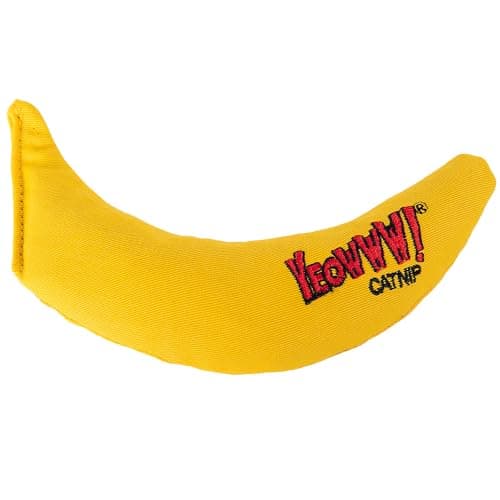
Seven inches of cotton twill with catnip and no filler, which is the only honest way to find out whether your cat is in the two-thirds that respond.
Published specs
| Length | 7" |
|---|---|
| Weight | 0.35 oz |
| Shell | Cotton twill |
| Fill | Organically grown catnip, no filler |
| Made in | USA, sewn and stuffed by hand |
Bol and colleagues tested 100 domestic cats and found one in three did not respond to catnip. So roughly 67 percent respond. If yours is in the other third, that is not a defective toy -- and the same study found almost 75 percent of catnip non-responders did respond to silver vine.
What the specs favor
- Catnip with no filler, so the whole toy is the active ingredient
- Big enough at 7 inches for bunny-kicking, which is the point of a kicker
- Cotton twill survives claws better than felt
- Refillable in practice -- the shell outlasts the catnip
What they don't
- Does nothing at all for roughly a third of cats, through no fault of the toy
- Catnip potency fades; the shell outlasts the effect
- No published catnip weight, only that there is no filler
Your cat has already ignored catnip twice. The research says go to silver vine rather than buying a third catnip toy.
How it scores
Scores are our editorial weighting of the published specs above, not a test result. They are deliberately kept out of this page's structured data.
Common questions
Are laser pointers bad for cats?
Do laser pointers cause frustration in cats?
Can a laser pointer damage a cat's eyes?
How long should a laser session last?
What is the right way to end a laser session?
Sources
- PetSafe -- Bolt Automatic Laser Light Cat Toy product page (15 minute automatic shut-off, 4 x AA, Certified Class 3 laser, mirror beam path)
- Amazon -- Go Cat Da Bird Single Pole Teaser on 36-inch Rod listing
- Yeowww! -- Chi-CAT-a Banana product page (7 in, cotton twill, organically grown catnip, no filler, made in USA)
- Ohio State University Indoor Pet Initiative -- For Cat Owners
- Cornell Feline Health Center -- feline health information
Read next
- Best Laser Pointers for Cats (2026)
Laser toys compared on published laser class and timer, with the technique that stops laser play ending in frustration.
- How to Play With a Cat
The hunt sequence a play session should follow, the four mistakes that end sessions early, and the toys that make the technique easy.
- Best Cat Wand Toys (2026)
Two wand toys compared on published construction, and how each one maps onto the stages of the hunting sequence.
- Cat Toy Safety
What is safe to leave out for a cat, what must be put away, and the household objects that cause most of the trouble.
- Best Automated Cat Toys (2026)
Motorized cat toys compared on published run time and batteries, with the per-session cost worked out.