Toys & Enrichment
How to Play With a Cat
Most people wave the toy at the cat. Prey does not approach a predator, and a cat that is never allowed to catch anything gives up on the game.
Affiliate disclosure: we earn a commission if you buy through our links, at no extra cost to you. It never changes which product we rank first — here is how we're funded.
Everyone in this category says they tested twenty litter boxes. We have not tested any, and we say so. What we do instead: compile the published specs, read the manuals, and do the arithmetic on what this gear costs to run and how it behaves once there is more than one cat using it. Every spec is linked to the document it came from. Prices are checked daily — last verified September 25, 2026. Here is exactly how we pick.
Cats are not bad at playing. People are bad at being prey, and the difference between a two-minute session and a fifteen-minute one is entirely in how the toy moves.
The sequence you are imitating
A hunt has stages: spot, stalk, chase, pounce, catch, and then eat. A play session that delivers all of them satisfies a cat. One that offers only the chase leaves it agitated, which is the complaint behind most reports that a cat gets over-excited during play.
The Ohio State Indoor Pet Initiative notes that cats prefer toys that squeak, chirp, jitter, swing or vibrate, recommends rotating a small batch rather than leaving everything out, and suggests food-delivery toys so cats feel they are catching a meal. All three of those follow from the sequence.
The technique, in order
- Start it small and far away. A twitch at the edge of the room reads as prey. A toy shaken in a cat’s face reads as a threat.
- Move away, never toward. Drag the lure out of reach and around corners. Nothing a cat hunts runs at it.
- Hide it. Let it disappear behind a chair leg or into a tunnel for a second or two. The pause is where the stalk happens.
- Let the cat win, repeatedly. A catch every minute or so, not once at the end.
- Wind down, then feed. Slow the lure, allow a final catch, then serve the meal. That is the whole sequence closed.
The four mistakes
| Mistake | What the cat sees | Fix |
|---|---|---|
| Waving the toy at the cat | Something coming toward it | Move the lure away and let it flee |
| Never allowing a catch | An unwinnable game | Let the cat hold the toy every minute or so |
| Using hands as toys | Hands are prey, including at 6am | Always put an object between hand and cat |
| Laser only | Prey that cannot be caught | Land the dot on a real toy and end there |
Compiled from the failure patterns readers describe most often, plus the published guidance on what cats prefer in a toy.
Toys that make it easy
Da Bird is the technique tool: a 36 inch rod and 50 lb line, with feathers that spin like something in flight. The length is the point -- it lets you fly the lure across a room and drop it, which is what makes the stalk possible.
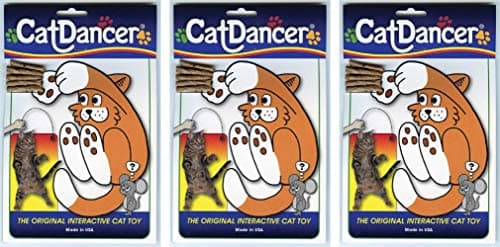
The Cat Dancer is 35 inches of spring steel wire with rolled cardboard on the end, and it moves in a way no rigid rod can. It is also the one to use for a slow, low session with an older cat.
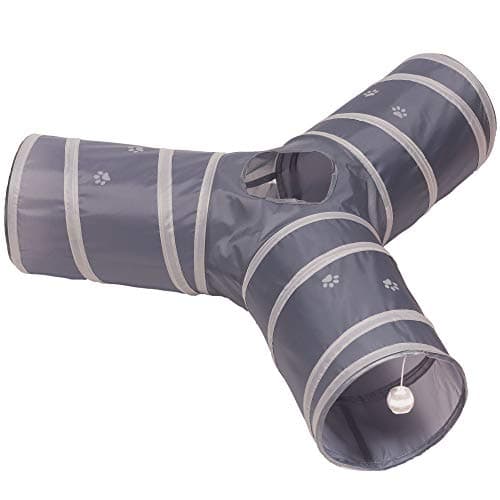
A three-way tunnel turns any wand into a better game: something to disappear into and ambush from, in about four square feet. Dragging a lure past a tunnel mouth is the single easiest way to get a proper stalk.
Adjusting for the cat
- Kittens: shorter, more frequent, and never with hands. Our kitten toy page covers what is safe to leave down.
- Older cats: keep the lure on the floor and slow. Our senior toy page covers toys that ask for less movement.
- High-energy cats: two or three sessions, and add solo outlets. Our high-energy page covers the wheel and tunnel side.
- Two cats: two wands, or one at a time. Our multi-cat play schedule sets out a routine that works across a week.
The gear discussed here
Specs are the manufacturer's own, linked to the page they came from. Prices come from a live daily check; where we have no verified price we say so rather than print a stale one.
Go Cat Da Bird Wand, 36-inch
Go Cat · Wand toy · Our score 8.8/10
#ad No verified live price right now, so we show none rather than a stale one. How we're funded.
A 36-inch rod on 50 lb braided line with feathers shaped to fly properly -- the only toy here that delivers the full hunt sequence, which is what boredom behavior is missing.
Published specs
| Rod length | 36" fiberglass, pull-apart |
|---|---|
| Line | 50 lb test braided nylon |
| Lure | Aerodynamically configured feathers |
| Refills | Feather attachments sold separately |
Source: Amazon -- Go Cat Da Bird Single Pole Teaser on 36-inch Rod listing
36 inches of rod and 32 inches of string is 68 inches of working radius, so the lure can travel a genuine arc across a room rather than bobbing in front of the cat. Short wands produce short, unconvincing movement, which is why cats lose interest in them within a minute.
What the specs favor
- 68 inches of combined reach -- real prey-like movement, not a bob
- 50 lb braided line does not snap mid-swing
- Rod pulls apart for storage
- Feather refills, so the rod outlasts many lures
What they don't
- Interactive only -- it does nothing while you are out
- Feathers are a consumable and a successful cat destroys them
- Must be put away; loose string is a swallowing hazard
You are looking for something to occupy the cat while you are at work. This one needs you on the other end of it, which is the whole point of it.
How it scores
Scores are our editorial weighting of the published specs above, not a test result. They are deliberately kept out of this page's structured data.
Cat Dancer 101
Cat Dancer Products · Wand toy · Our score 8.1/10
#ad Price as of September 25, 2026. Prices move; we check daily. How we're funded.
Thirty-five inches of spring steel wire with rolled cardboard on the end -- the flex is the feature, because a springy wire moves in ways a human wrist cannot fake.
Published specs
| Wire | 35" spring steel |
|---|---|
| Lure | Rolled cardboard twists |
| Made in | USA |
| Handle | The wire itself; no rigid rod |
Go Cat's Da Bird uses a 36 inch fiberglass rod plus line. The Cat Dancer is 35 inches of wire that bends through the whole stroke. Nearly the same reach, completely different motion: the rod moves where you point it, the wire keeps moving after you stop.
What the specs favor
- Spring wire produces erratic motion no rigid rod reproduces
- Nothing to break, nothing to refill
- Light enough to leave hanging on a door handle, which is why it gets used
- Made in the USA, published on the listing
What they don't
- Bare wire end is sharp enough to want putting away between sessions
- Cardboard lures shred, which is a consumable in all but name
- Too light to interest some large cats
You want a toy the cat can play with alone. This is not that, and no wand toy should be left out for a cat to use unsupervised.
How it scores
Scores are our editorial weighting of the published specs above, not a test result. They are deliberately kept out of this page's structured data.
Prosper Pet Collapsible Cat Tunnel
Prosper Pet · Cat tunnel · Our score 7.8/10
#ad Price as of September 25, 2026. Prices move; we check daily. How we're funded.
Three tubes and over fifty inches of run on a sprung-steel frame, which turns an open floor into something a cat can stalk across.
Published specs
| Configuration | 3-way, over 50 inches of total tunnel |
|---|---|
| Tube size | About 10" tall, 17" deep per tube |
| Shell | 190T polyester, tear resistant |
| Frame | Sprung steel with protective ends |
| Features | Crinkle paper lining, peephole, bell toy |
| Storage | Folds flat with an elastic band |
| Washing | Washable |
Three 17 inch tubes radiating from a hub occupy roughly a 24 inch square of floor, about 4 square feet, and deliver over 50 inches of enclosed run. Nothing else on this site converts floor into cover at that ratio, which is why a tunnel is the cheapest fix for a room with nowhere to hide.
What the specs favor
- Three exits, so a cat entering can always leave another way
- Sprung frame means the center does not collapse on the cat
- Folds flat, so it can be put away and reintroduced as novelty
- Washable, which a floor-level fabric item needs to be
What they don't
- Crinkle lining is loud enough to be a household consideration
- Polyester shell snags on claws over time
- Not a substitute for vertical space -- it is cover, not height
Your problem is a cat with nowhere high to go. A tunnel adds cover at floor level, and a cat looking for a lookout wants the opposite.
How it scores
Scores are our editorial weighting of the published specs above, not a test result. They are deliberately kept out of this page's structured data.
Common questions
How do you play with a cat properly?
How long should a play session be?
Why does my cat lose interest during play?
Are laser pointers bad for cats?
Should I play with my cat before bed?
Sources
- Amazon -- Go Cat Da Bird Single Pole Teaser on 36-inch Rod listing
- Cat Dancer Products -- Cat Dancer 101 listing (35 in spring steel wire, rolled cardboard, made in USA)
- Prosper Pet -- Collapsible 3 Way Cat Tunnel listing (about 10 in tall and 17 in deep per tube, over 50 in total, 190T polyester over sprung steel)
- Ohio State University Indoor Pet Initiative -- Toys
Read next
- Best Cat Wand Toys (2026)
Two wand toys compared on published construction, and how each one maps onto the stages of the hunting sequence.
- A Play Schedule for a Multi-Cat House
Why joint play sessions fail in a multi-cat home, and a separate-session routine that fits around a job.
- Signs Your Cat Is Bored
What under-stimulation looks like in an indoor cat, which signs are veterinary questions, and the free changes to try first.
- Best Cat Toys for High-Energy Cats (2026)
Toys for high-energy cats compared on what they tire out: the hunt, the sprint and the ambush, with a play pattern that ends in sleep.
- Cat Toy Safety
What is safe to leave out for a cat, what must be put away, and the household objects that cause most of the trouble.