Beds, Carriers & Daily Care
How to Help Outdoor Cats in Winter
Most of what people put in an outdoor shelter makes it colder. The fix is counterintuitive, cheap, and mostly about moisture rather than insulation.
Affiliate disclosure: we earn a commission if you buy through our links, at no extra cost to you. It never changes which product we rank first — here is how we're funded.
Everyone in this category says they tested twenty litter boxes. We have not tested any, and we say so. What we do instead: compile the published specs, read the manuals, and do the arithmetic on what this gear costs to run and how it behaves once there is more than one cat using it. Every spec is linked to the document it came from. Prices are checked daily — last verified October 19, 2026. Here is exactly how we pick.
Pack the shelter with straw, not blankets — blankets absorb moisture and freeze against the cat. Keep the shelter small, because it is heated by the cat’s own body. Give it two exits. Then solve water, which is the harder half: a 12 W thermostatic heated bowl runs about $6.34 for a whole winter at the ceiling, and nothing else reliably works.
The mistake almost everyone makes
People put blankets, old towels, fleece and cushions into outdoor shelters, because that is what warmth looks like indoors. Outdoors it is actively harmful, and the mechanism is moisture rather than temperature.
Fabric absorbs water — from rain tracked in on fur, from snow, and from the cat’s own breath and body over a long night. Once damp, it holds that water against the animal and conducts heat away far faster than dry air does. In a hard freeze it stiffens. A cat sleeping on a damp blanket at 20 F is colder than the same cat on a bare insulated floor.
Straw behaves the opposite way. The stems are hollow, so it traps a lot of still air; it sheds water rather than soaking it up; and a cat can burrow into it, which puts insulation underneath and around the animal instead of just under it. Not hay — hay is dried grass, it absorbs water and it molds.
Why smaller is warmer
There is no heater in an unpowered shelter. The only heat source is the cat, which produces a small, fixed amount. So the question is how much air that heat has to warm.
The PETSFIT insulated house publishes an interior of 22 x 17 x 15 inches, with foam panels on all walls and the roof. Its interior footprint is 374 square inches of a 456 square inch exterior — so the insulation itself is eating about 18 percent of the outside dimensions, which is exactly what you want it doing.
Double that interior volume and the same cat has twice as much air to warm with the same body. This is why a big dog kennel is a poor cat shelter and why a correctly sized box beats it in a freeze.
It is also why several cats sharing is good. Two cats in one small shelter is not crowding; it is two heat sources in a volume sized for one.
Shelter and station, on published figures
| PETSFIT Insulated House | K&H Thermo-Kitty Cafe | K&H Thermal-Bowl | |
|---|---|---|---|
| Job | Shelter, no power needed | Heated food + water station | Heated water only |
| Exterior | 24" L x 19" W x 19" H | Not published | Not published |
| Interior | 22" L x 17" W x 15" H (374 sq in) | N/A | N/A |
| Insulation | Foam panels on all walls and roof | N/A | N/A |
| Exits | Main door with PVC curtain plus escape door | N/A | N/A |
| Power | None | Thermostatic; wattage not published | 12-25 W by size |
| Bowl material | N/A | 302 stainless steel | Plastic; one stainless variant |
| Capacity | N/A | 24 oz water + 12 oz food | 32 oz to 1.5 gal by size |
| Safety listing | N/A -- unpowered | MET listed | MET listed |
| Cord | None | 5.5 ft, no extension cord | 5.5 ft, no extension cord |
| Electricity, 120-day winter | $0.00 | Not computable -- no published wattage | About $6.34 at 12 W, ceiling |
Manufacturers' published figures as named in our sources. The Thermo-Kitty Cafe genuinely publishes no wattage and no dimensions, so its running cost cannot be stated.
Setting the shelter up
- Raise it off the ground. Two bricks or a pallet. Ground contact wicks heat out and lets meltwater in.
- Two openings, one sheltered. A single door is a trap. Face the main opening away from prevailing wind, and keep both small — a cat-sized hole loses less heat than a generous one.
- Pack it with straw, generously. Not a layer on the floor — enough that the cat has to burrow. Top it up when it flattens or gets damp.
- Put it somewhere quiet and against something. A wall, a fence, under a deck. Shelter from wind matters as much as the box itself.
- Do not block the entrance to keep heat in. A flap or a curtain is fine; anything a cat has to fight is a shelter it stops using.
- Check it without disturbing it. Community cats abandon shelters that smell of frequent human handling. Top up straw and water and leave.
Water is the harder problem
A shelter works unattended all winter. Water does not: a bowl put out in the morning is ice by lunchtime, and the tricks people try — deeper bowls, warm water, a ping-pong ball on the surface, a dark bowl in the sun — buy minutes to an hour. In a real freeze the only thing that works is a thermostatic heated bowl, and the good news is that it is cheap: about $6.34 of electricity for a whole 120-day winter on a 12 W unit at the published ceiling, and nearer half that in practice.
The constraint is not cost but the cord. Both makers state the unit should not be used with an extension cord, and the K&H cord is 5.5 feet. Plan the outlet — ideally a GFCI outlet — before you plan the station. Our heated water bowls page works through the three live options and what each maker will and will not publish.
The kit, and who each piece is for
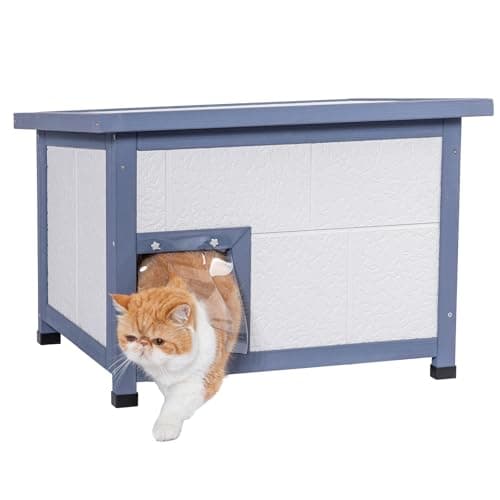
The PETSFIT insulated outdoor house is the pick where there is no power, which is most places. Foam panels on all walls and the roof, a published interior of 22 by 17 by 15 inches, a main door with a PVC curtain and a separate escape door — so it meets the two-exit rule out of the box rather than needing modification. For: gardens, yards and alleys with no outlet; one or two regular cats. Skip it if: you have several cats and only one shelter — buy two small ones rather than one large one, because volume is the enemy.
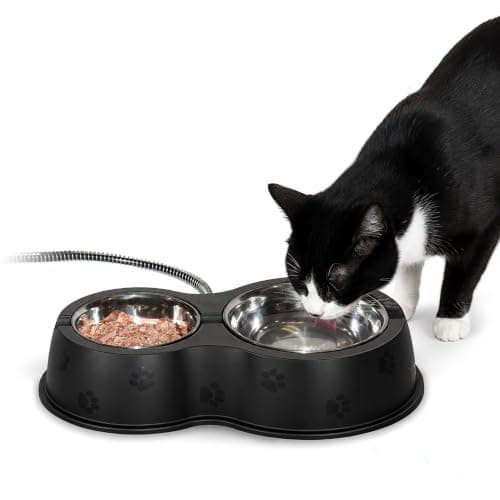
The K&H Thermo-Kitty Cafe is the pick if you have power and you are feeding as well as watering. Two 302 stainless bowls, 24 oz and 12 oz, thermostatic for both food and water, MET listed, one plug. Stainless matters outdoors: it wipes clean and does not hold odor the way plastic does. For: established community cat feeding stations near an outlet. Skip it if: you want to know the running cost — K&H publishes no wattage and no dimensions for this unit, so it is the one thing here we cannot cost.
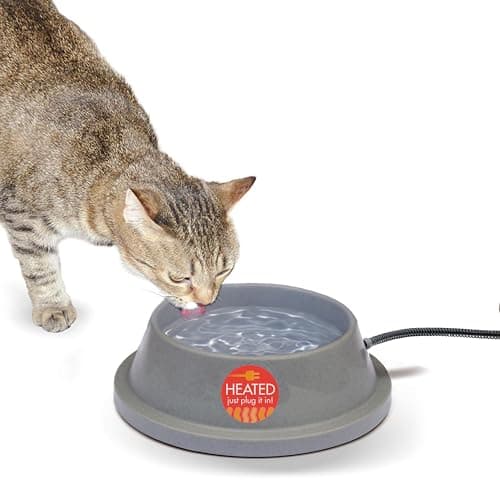
The K&H Thermal-Bowl is the pick if water is all you need, and it is the cheapest heated thing to run here at a published 12 W on the small variant. MET listed for outdoor use, 5.5 ft wrapped chew-resistant cord, four sizes with inside dimensions published for three of them so you can match it to a porch or a shelter entrance. For: one or two cats, a porch or garage with an outlet. Skip it if: you are watering a colony — size up, and expect to refill it daily regardless of the heater.
What this does and does not solve
- Shelter and water are not veterinary care. A thin, limping, injured or visibly sick cat needs more than straw. The Cornell Feline Health Center is the place to start reading, and a local TNR or rescue group is the place to call.
- Feeding outdoor cats is a commitment, not a gesture. Cats come to rely on a station. Starting one in November and stopping in January is worse than never starting.
- Check with neighbors and local rules. Feeding stations and shelters sit in other people’s sight lines, and in some places there are ordinances about it.
- Check under the car. Cats sleep against warm engines and in wheel arches. Bang the hood before you start the engine in winter.
The rest of the setup
Our outdoor cat houses page ranks the shelters on published insulation and interior volume, and heated water bowls covers the water half in full. For the cats already indoors, keeping cats warm in winter is the cheaper and easier problem.
The gear discussed here
Specs are the manufacturer's own, linked to the page they came from. Prices come from a live daily check; where we have no verified price we say so rather than print a stale one.
PETSFIT Insulated Outdoor Cat House
PETSFIT · Outdoor cat house · Our score 8.0/10
#ad Price as of October 19, 2026. Prices move; we check daily. How we're funded.
Foam-insulated on every wall and the roof, with an escape door and PVC door curtains -- the best unheated option, and it publishes interior dimensions.
Published specs
| Exterior | 24" L x 19" W x 19" H |
|---|---|
| Interior | 22" L x 17" W x 15" H |
| Insulation | Foam panels on all walls and roof |
| Doors | Main door with PVC curtain, plus escape door |
| Power | None |
Interior 22 x 17 = 374 square inches inside a 24 x 19 = 456 exterior. The difference is the insulation, which is doing the work a heater does in a powered house. Bed it with straw rather than blankets -- blankets hold moisture.
What the specs favor
- Needs no power at all
- Interior dimensions published
- Escape door, so a cat is never cornered
- Curtained door keeps wind out
What they don't
- No heat source; warmth depends on insulation and bedding
- Bedding must be kept dry and changed
- Assembly required
Your winters are severe and you have a safe outdoor socket. A safety-listed heated house does more in deep cold.
How it scores
Scores are our editorial weighting of the published specs above, not a test result. They are deliberately kept out of this page's structured data.
K&H Thermo-Kitty Cafe Heated Feeding Station
K&H Pet Products · Heated water bowl · Our score 7.6/10
#ad Price as of October 19, 2026. Prices move; we check daily. How we're funded.
Two stainless bowls on one heated base -- 24 oz and 12 oz, thermostatic, MET listed -- and the only unit here that keeps food from freezing as well as water.
Published specs
| Model | HPB70 |
|---|---|
| Bowls | 24 oz larger, 12 oz smaller |
| Bowl material | 302 stainless steel |
| Thermostat | Thermostatically controlled, food and water, sub-zero rated by the maker |
| Switch | None -- the pad is always on when plugged in |
| Cord | 5.5 ft, protection wrapped and abrasion resistant |
| Extension cords | Maker says do not use one |
| Safety listing | MET listed for safety |
| Wattage | Not published |
| Dimensions | Not published |
| Warranty | 1 year limited |
Every running-cost figure on this site is built from a published power rating. K&H publishes a wattage for the Thermal-Bowl (12-25 W depending on size) and publishes NO wattage at all for the Thermo-Kitty Cafe, nor any dimension. So we cannot cost this unit, and neither can anyone else who is being honest. If it sits in the same 12-25 W band as its sibling, a 120-day winter is somewhere between $6.34 and $13.20 at 18.34 cents/kWh -- but that band is our inference from the sibling product, not a figure K&H states about this one.
What the specs favor
- Keeps food unfrozen as well as water, which no plain bowl does
- 302 stainless bowls rather than plastic, so they wipe clean and do not hold odor
- Two bowls at two sizes on one heated base and one plug
- MET listed, with the same 5.5 ft wrapped cord as the Thermal-Bowl
- Designed around feral and community cat feeding specifically
What they don't
- No published wattage, so it is the one heated unit here we cannot cost
- No published dimensions either, so you cannot plan a shelter around it
- No on/off switch
- 24 oz of water is modest if several cats use it
- The most expensive unit here by a clear margin
You only need water. The second bowl and the higher price buy you heated food, and if you are not leaving food out the plain Thermal-Bowl does the same job for less.
How it scores
Scores are our editorial weighting of the published specs above, not a test result. They are deliberately kept out of this page's structured data.
K&H Thermal-Bowl Heated Water Bowl
K&H Pet Products · Heated water bowl · Our score 8.4/10
#ad Price as of October 19, 2026. Prices move; we check daily. How we're funded.
A thermostatic outdoor bowl that draws as little as 12 watts and is MET listed for outdoor use -- and whose maker will not tell you the temperature it switches on at.
Published specs
| Wattage | 12-25 W depending on size; K&H publishes no per-variant figure |
|---|---|
| This listing | 12 W variant |
| Sizes offered | 32 oz, 96 oz, 1.5 gal, 102 oz stainless |
| Inside dimensions | 96 oz: 8" dia x 3.5" deep; 1.5 gal: 10" dia x 4.25"; stainless 102 oz: 9" dia x 2.5" |
| Thermostat | Thermostatically controlled, on and off automatically |
| Switch | None -- the pad is always on when plugged in |
| Cord | 5.5 ft, protection wrapped and abrasion resistant |
| Extension cords | Maker says do not use one |
| Safety listing | MET listed, stated to exceed UL requirements |
| Activation temperature | Not published |
| Minimum ambient rating | Not published |
| Warranty | 1 year limited |
12 W is a CEILING, not a measurement: the bowl is thermostatic, so it only draws when it is fighting the cold. 12 W x 2,880 hours (120 days, 24 h) = 34.56 kWh, and at the EIA residential average of 18.34 cents/kWh that is $6.34 for the whole winter. A thermostat that cycles roughly half the time puts the real figure nearer $3.17. The honest problem is that K&H publishes no switching band, so the duty cycle cannot be estimated from anything the maker says.
What the specs favor
- The lowest published draw in the category at 12 W
- MET listed specifically for outdoor use, which not every heated bowl is
- Chew-resistant wrapped cord at 5.5 ft
- Four sizes, three of them with published inside dimensions
- Thermostatic, so it is not heating water it does not need to
What they don't
- No published activation temperature, so duty cycle and real cost are unknowable
- No on/off switch at all -- unplugging is the only way to stop it
- No per-variant wattage published; 12-25 W covers the whole range
- Maker says not to use an extension cord, which is where most outdoor setups fail
- No minimum ambient temperature rating published
You need a bowl indoors. A heated bowl solves freezing, not drinking, and indoors it is solving a problem you do not have.
How it scores
Scores are our editorial weighting of the published specs above, not a test result. They are deliberately kept out of this page's structured data.
Common questions
What is the best bedding for an outdoor cat shelter?
Should an outdoor cat shelter be big or small?
Does an outdoor cat shelter need two exits?
How do you keep outdoor cat water from freezing?
Can you put a heated pad in an outdoor cat house?
Sources
- PETSFIT -- Insulated Outdoor Cat House listing (24 x 19 x 19 in exterior, 22 x 17 x 15 in interior, all-round foam panels, escape door, PVC curtains)
- K&H Pet Products -- Thermo-Kitty Cafe product page (model HPB70, 24 oz and 12 oz 302 stainless steel bowls, thermostatically controlled for food and water, no on/off switch, 5.5 ft protection-wrapped cord, MET listed, 1-year limited warranty; wattage and dimensions NOT published)
- K&H Pet Products -- Thermal-Bowl product page (12-25 W depending on size, thermostatically controlled with no on/off switch, 5.5 ft protection-wrapped cord, MET listed, 1-year limited warranty; no activation temperature or minimum ambient rating published)
- U.S. Energy Information Administration, Electric Power Monthly Table 5.3 -- residential average 18.34 cents/kWh, June 2026
- Cornell Feline Health Center -- feline health information
Read next
- Best Outdoor Cat Houses (2026)
Heated and unheated outdoor shelters compared on published insulation, doors and dimensions, with the full winter electricity arithmetic.
- Best Heated Cat Water Bowls (2026)
Heated bowls ranked on what their makers publish: a 12 W draw worth $6.34 a winter at the ceiling, the one thermostat band anybody states, and the unit that cannot be costed.
- How to Keep Cats Warm in Winter
Winter warmth in cost order: the free draft and placement fixes that do most of the work, then a 4 W thermostatic pod that costs about $2.11 for a 120-day winter.
- Best Cat-Proof Window Screens (2026)
Pet-resistant screening compared on published strength and openness, with the frame check and the perch that suits a screened window.
- The Multi-Cat Household Guide
The pillar guide: resource counts by household size, why separation beats quantity, and the order to fix things in.